UK Greyhound Derby Final — What You Will Find in This Complete Guide
What Makes the Greyhound Derby Final the Biggest Night in Dog Racing
Six traps. 500 metres of sand. One race that defines an entire sport. The English Greyhound Derby final is not just another Saturday night at the track — it is the single most anticipated event in British greyhound racing, and it has been since 1927. Every year, roughly 192 dogs enter the competition. Five weeks later, six remain. The final itself lasts about 28 seconds, and the winner walks away with a prize pot that dwarfs every other race on the UK calendar.
For bettors, the Derby final is a different proposition from the daily graded cards that run at tracks across the country. The competition format — a multi-round knockout stretching from early May through to mid-June — tests consistency over weeks, not speed in a single burst. The dogs that make the final have survived heats, quarter-finals, and semi-finals. They have run the same 500-metre Towcester course repeatedly, building form that can be tracked, compared, and analysed in ways that ordinary meetings rarely allow. That depth of data is a bettor's advantage, if you know where to look.
This guide covers every angle of the Greyhound Derby final from a betting perspective. The format and how it shapes the competition. The betting markets available — from outright and ante-post to forecasts and tricasts. How to read and compare odds across bookmakers. Form analysis specific to the Derby. Strategy backed by decades of data. And the trap draw analysis that too many punters overlook. Whether you are planning your first Derby bet or refining a long-standing approach, the aim here is practical: give you the information that actually changes decisions, not just fills a page.
Key Facts
- Race: English Greyhound Derby (Star Sports/TRC)
- Distance: 500 metres
- Surface: Sand
- Venue: Towcester Greyhound Stadium, Northamptonshire
- Prize Money: £175,000 to the winner
- 2025 Champion: Droopys Plunge (trainer: Patrick Janssens, 10/1)
- Format: Multi-round knockout — 192 entries to a 6-dog final
- Governing Body: Greyhound Board of Great Britain (GBGB)
Kalkulačka reálné hodnoty bonusu
Kasino vám slíbí 5 000 Kč zdarma. Kolik z toho vám po splnění protáčecích podmínek reálně zůstane? Zadejte parametry nabídky a spočítejte si to za 10 sekund.
Pokročilé nastavení (tempo hry a limit výběru)
Jak počítáme: Vycházíme z matematického očekávání. Celkový obrat × (100 % − RTP) je částka, o kterou v průměru přijdete cestou ke splnění podmínek. Čistá hodnota bonusu = bonus − tato očekávaná ztráta. Skutečný výsledek jednotlivé session se kvůli volatilitě může lišit v obou směrech, někdy výrazně — kalkulačka ukazuje dlouhodobý průměr, ne předpověď. CasinoScope Index váží reálnou hodnotu bonusu (70 %), splnitelnost v dané lhůtě (15 %) a férovost podmínek — příspěvek her, platnost a základ protáčení (15 %).
18+Hazardní hra může způsobit závislost. Hrajte pouze za peníze, které si můžete dovolit prohrát. Pomoc nabízí Projekt Re-set i Anonymní Gambleři — anonymně a zdarma.
How the Derby Works: From 192 Entries to the Final Six
The Derby is a war of attrition — and the final is what's left standing. Unlike a standalone race where six dogs line up and one wins, the English Greyhound Derby is a knockout competition that unfolds over approximately five weeks. It begins with around 192 entries, split into heats of six, and by the time the final night arrives, only six dogs remain. That process — the gradual elimination, the accumulating form data, the shifting odds — is what makes the Derby the best-studied event in greyhound racing from a betting standpoint.
The structure rewards durability. A dog can run an outstanding time in the first round and still be eliminated in the quarter-finals if it cannot handle the bend at Towcester or falters under race-night pressure. Conversely, a dog that qualifies without winning a single heat can improve through the rounds and peak on final night. For bettors, this matters: the competition format itself generates information that most other greyhound events simply do not produce.
Each round typically sees six dogs per heat, with the first three home qualifying for the next stage. You do not need to win to progress — finishing second or third is enough. But the margins are slim. A stumble at the first bend, a check on the run to the line, and qualifying becomes elimination.
Open race — a race with no grading restrictions, open to the best dogs regardless of their classification. The Derby is the most prestigious open race in British greyhound racing, distinct from the graded meetings that form the weekly racing calendar at GBGB-licensed tracks.
Round-by-Round Breakdown
Each round eliminates the unlucky and exposes the unprepared. The Derby typically runs on a weekly cycle, with heats held on a Saturday night at Towcester. Here is the standard progression, as used in recent editions of the competition:
First Round: 192 entries are divided into 32 heats of 6 dogs. The first three finishers in each heat advance. This is the largest field and the most volatile stage — dogs are unfamiliar with each other's running lines, and course knowledge at Towcester is still developing. Roughly 96 dogs progress.
Second Round: The field narrows again through a further set of heats. Three from each heat qualify. By now, the Towcester track is becoming familiar, and dogs with strong early pace or reliable cornering begin to stand out. The field drops to approximately 48.
Third Round: Another cut. The competition is now deep enough that every heat contains quality, and there are no easy draws. Trainers begin to manage their entries more carefully — tactical decisions about feeding, exercise, and trial runs become critical. Around 24 dogs survive to the quarter-finals.
Quarter-Finals: Four heats of six. The talent concentration is now extreme. Each heat is effectively a high-class open race in its own right. Twelve dogs advance. This is often the stage where ante-post favourites face their sternest test — a poor draw or an unlucky check can end a campaign regardless of ability.
Semi-Finals: Two heats of six. The final twelve dogs split into two races. The first three home from each semi qualify for the final. This is where the picture crystallises for bettors: you can now see exactly how the finalists have performed across multiple rounds on the same track, and odds for the final are set in earnest.
The Final: Six dogs. One race. £175,000 to the winner. The culmination of everything.
What Happens on Final Night
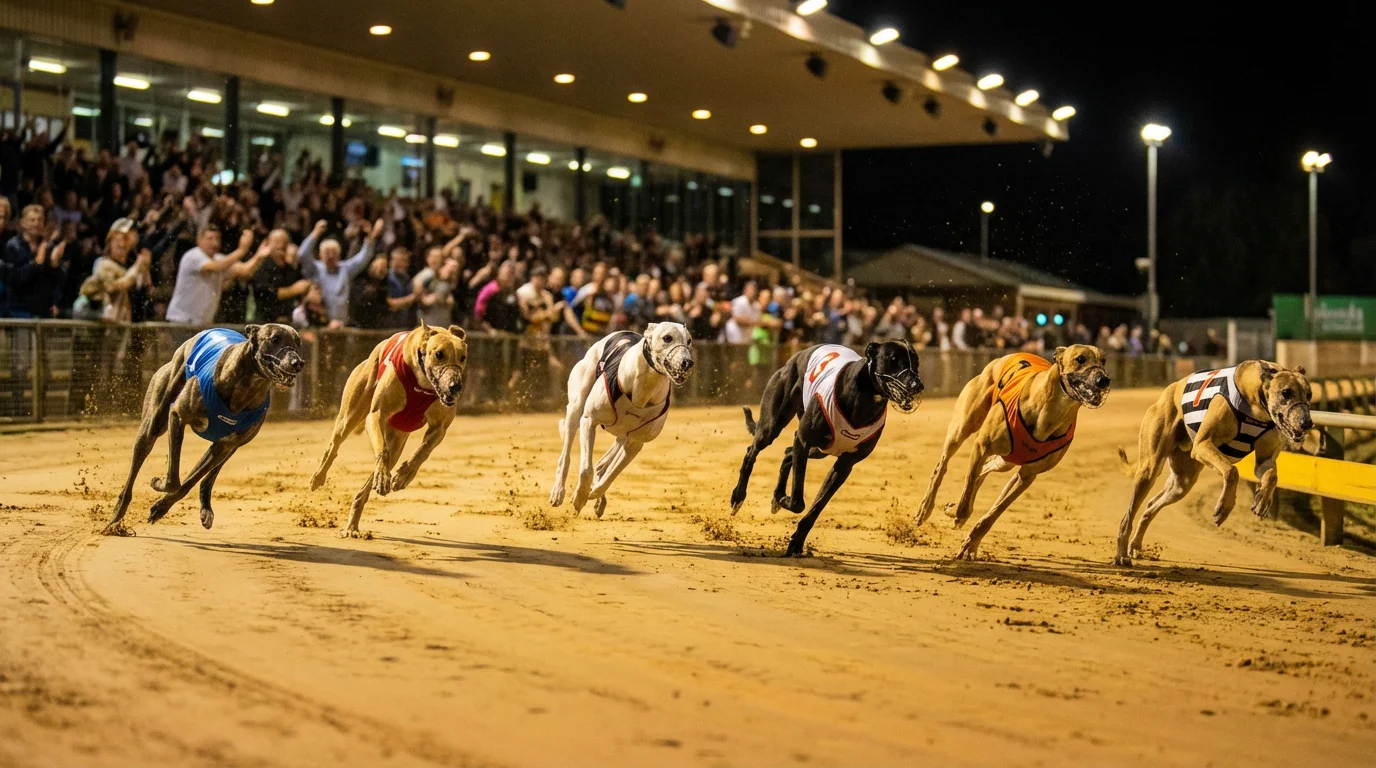
By the time the lids go up in the final, the only thing left is 28 seconds of controlled chaos. Final night at Towcester is a full racing card — typically fifteen races across the evening — but the Derby final, scheduled at around 9:15pm, is the event that fills the grandstands and drives the betting turnover. Everything else is undercard.
The trap draw for the final is conducted after the semi-finals, usually earlier in the final week. This draw is critical: trap position determines where a dog starts in relation to the first bend, and at Towcester's 500m layout, the run to that first bend is where races are often won or lost. Once the draw is announced, the betting market reacts immediately. A dog drawn in trap 1 on the rail may shorten; a wide runner drawn on the outside in trap 6 may drift. The final's ante-post odds from the outright market are replaced by race-night prices that reflect the specific circumstances of the six remaining dogs.
On the night itself, the atmosphere is markedly different from a standard meeting. Crowds at the Derby final regularly reach several thousand, with a family festival atmosphere, live entertainment, and support races including the Puppy Trophy and Sprint Trophy. For bettors watching remotely, the race is streamed live by most major UK bookmakers, on SIS Racing, and through the Gone To The Dogs live broadcast. The build-up is extensive, but the race itself is over almost before it starts. The 500m trip at Towcester typically takes between 28.40 and 29.00 seconds. There is no time for mistakes and very little room for a dog to recover from a slow start or a wide run on the bends.
The 2025 Derby final produced one of the tightest finishes in recent memory — Droopys Plunge beat the defending champion De Lahdedah and Irish Derby winner Bockos Diamond, posting the fastest first-bend sectional of all six finalists at 4.03 seconds despite starting as a 10/1 shot.
Betting Markets for the Greyhound Derby
Knowing your markets is not optional — it is the difference between punting and betting. The Greyhound Derby offers a wider range of betting opportunities than almost any other event in British dog racing, and the sheer duration of the competition means you can bet at different stages, in different ways, for different purposes. Understanding which market fits which situation is foundational to any coherent Derby betting approach.
The core markets available across all major UK bookmakers for the Derby are: outright winner (ante-post), individual heat betting (win, each-way), forecast and tricast bets, and — for the final specifically — a full complement of race-night markets including live in-play options. Some bookmakers also offer specials such as top trainer, winning trap colour, and without-the-favourite markets. The availability of these varies by operator, but the fundamentals are consistent.
The critical distinction for Derby betting is between ante-post markets and race-night markets. Ante-post bets are placed before the competition starts or during the early rounds, at odds that reflect uncertainty about which dogs will even reach the final. Race-night bets are placed once the six finalists are confirmed and drawn, at odds that reflect a much clearer picture. Each carries different risk-reward profiles, and experienced punters typically use both at different stages of the competition.
Below is a practical example of how an each-way bet works on the Derby final — the most popular bet type for a six-runner field.
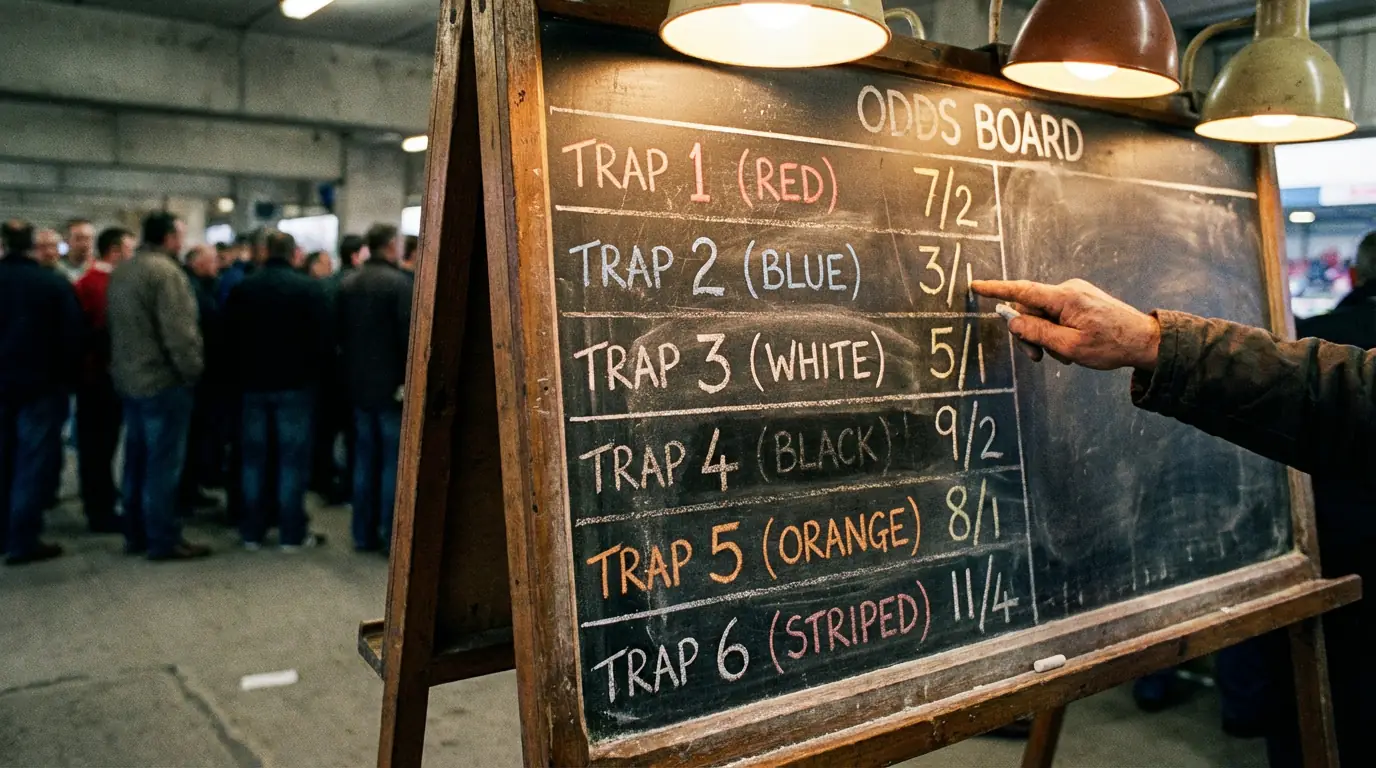
Example: Each-Way Bet on the Greyhound Derby Final
Runner: Dog X | Trap 3 | Odds: 10/1
Stake: £10 each way (total outlay: £20)
Each-way terms: 1/4 odds, places 1-2
If Dog X wins: £10 x 10/1 = £100 profit (win part) + £10 x 10/4 = £25 profit (place part) = £125 profit + £20 stakes returned = £145 total return
If Dog X finishes 2nd: Win part loses (−£10). Place part pays: £10 x 10/4 = £25 profit + £10 stake = £35 return. Net result: +£15
If Dog X finishes 3rd–6th: Both parts lose. Total loss: £20
Notice that in a six-runner race, the each-way terms are typically 1/4 of the odds for first and second place only. This is tighter than horse racing, where larger fields offer more places. The impact is that each-way betting in greyhounds is most valuable at longer prices — at short odds, the place part of the bet offers minimal return relative to your total outlay.
Outright and Ante-Post Betting
Ante-post is where the biggest prices hide — and the biggest risks. When you bet on a dog to win the Derby outright before the competition begins, you are accepting a fundamental trade-off: you get significantly better odds, but your stake is at risk if the dog is injured, eliminated, or withdrawn at any stage. Ante-post bets on the Greyhound Derby are typically settled on an "all-in, run or not" basis. If your dog does not make the final, you lose your money.
The ante-post market usually opens months before the first heat. At that stage, prices are wide and speculative. The defending champion and notable open-race performers tend to head the early market, but the field is so large and the competition so unpredictable that double-digit odds on genuine contenders are common. In 2025, Droopys Plunge — the eventual winner — was available at 33/1 in the ante-post lists before the competition started, and was still 10/1 on final night. That kind of price movement is the fundamental appeal of early betting.
However, ante-post carries real risk. Irish entries, which have dominated recent Derbies, may be withdrawn due to injury or diverted to the Irish Derby. Dogs can underperform in the first round and be eliminated regardless of their overall ability. For bettors, the key decision is timing: too early and you are guessing; too late and the value has already been absorbed by the market. The sweet spot is often after the first or second round, when you have meaningful Towcester form but before the odds contract sharply heading into the quarter-finals.
Outright betting does not require you to bet ante-post. You can also back a dog outright on final night, though the odds will be considerably shorter. For the 2026 Derby, the ante-post market is expected to open in the spring, with Star Sports — the title sponsor — typically among the first bookmakers to price the competition.
Heat, Each-Way, Forecast and Tricast
If you are not using each-way terms on a six-runner field, you may be leaving value on the table — but only at the right prices. Let us break down the race-level markets that apply to individual heats and the final itself.
Win betting is the simplest form: you back a dog to finish first. In greyhound racing, there is no dead-heat rule complication in most circumstances — first past the post takes the prize, and your bet pays out at the advertised odds. Win betting is straightforward but offers no safety net if your selection finishes a close second.
Each-way betting splits your stake into two equal parts — one on the win, one on the place. In a standard six-runner greyhound race, the place terms are typically 1/4 of the odds for first and second. This means each-way becomes mathematically attractive mainly at longer odds. Backing a 2/1 shot each-way returns only an additional half-point profit on the place part, while backing a 10/1 shot each-way gives you a useful cushion — the place portion alone returns 2.5/1 if the dog finishes in the first two.
Forecast betting requires you to predict the first two finishers. A straight forecast names them in exact order; a reverse forecast covers both permutations (your two dogs in either finishing order, effectively two bets for double the stake). Forecast dividends in greyhound racing are calculated by the Computer Straight Forecast (CSF), which reflects the actual market on the race rather than a fixed multiplier. This means payouts can vary considerably — a correctly predicted forecast involving two outsiders can return handsomely.
Tricast betting takes it further: name the first three finishers in exact order. In a six-dog race, there are 120 possible tricast combinations, which is why payouts can be substantial. A combination tricast covers all possible orderings of your three selected dogs — six permutations, six times the stake. Tricasts are high-risk bets best suited to races where you have strong views on which three dogs will fill the frame but less certainty about their exact order.
Reverse Forecast Calculation Example
You believe Dog A and Dog B will finish 1st and 2nd in a Derby heat, but you are not sure of the order.
Stake per line: £5
A reverse forecast = 2 bets (A-B and B-A) = £10 total stake
Result: Dog B wins, Dog A finishes 2nd
CSF dividend declared: £24.50 to a £1 stake
Your return: £5 x £24.50 = £122.50
Net profit: £122.50 − £10.00 (total stake) = £112.50
Note: Only the winning permutation (B-A) pays. The other line (A-B) loses.
How to Read and Compare Greyhound Derby Odds
Odds are not predictions — they are a mirror of money. Understanding this distinction is essential for anyone betting on the Derby. Bookmaker odds reflect a combination of the perceived probability of each dog winning and the margin the bookmaker builds into the market. When you see a dog priced at 3/1, the market is implying roughly a 25% chance of winning — but with the bookmaker's overround factored in, the true implied probability is slightly higher than the raw odds suggest. Learning to read odds properly means learning to see through the margin to the actual assessment underneath.
In UK greyhound racing, fractional odds remain the standard format. A price of 5/2 means you receive £5 in profit for every £2 staked, plus your £2 stake returned. Decimal odds — more common on exchanges like Betfair — express the same information differently: 5/2 becomes 3.50 (your total return per £1 staked, including the stake). Both formats convey the same probability; the choice is largely about personal preference, though decimal odds make comparison and calculation marginally easier, particularly when dealing with complex multiples.
The bookmaker's overround is the built-in margin on a race. In a theoretically fair six-dog race, the implied probabilities should sum to 100%. In practice, they typically sum to between 115% and 130%. The lower the overround, the better the value for bettors. Derby heats tend to carry slightly tighter overrounds than standard graded races because the high-profile nature of the competition attracts competitive pricing from bookmakers.
Comparing odds across bookmakers is not a luxury — it is a basic discipline. The same dog in the same Derby heat can be priced at 7/2 with one operator and 4/1 with another. Over a full competition, consistently taking the best available price adds measurable value. The difference between 7/2 and 4/1 on a £10 win bet is £5 — seemingly modest, but across dozens of bets over the Derby cycle, this compounds into a meaningful edge.
| Bookmaker A | Bookmaker B |
|---|---|
| Dog X: 3/1 | Dog X: 7/2 |
| Dog Y: 5/1 | Dog Y: 5/1 |
| Dog Z: 9/2 | Dog Z: 4/1 |
| Overround: 122% | Overround: 118% |
In this example, Bookmaker B offers better odds on Dog X (7/2 vs 3/1) and a lower overround overall. Backing Dog X with Bookmaker B returns an extra £5 profit per £10 stake compared to Bookmaker A. Over a full Derby, those differences add up.
The starting price (SP) deserves particular attention. SP is the official price returned on a dog at the moment the traps open. If you have not taken a fixed price earlier, your bet settles at SP. Many bookmakers offer Best Odds Guaranteed (BOG) on greyhounds, which means if you take a price and the SP is higher, you receive the better price. Not all operators extend BOG to greyhound racing — checking this before the Derby is worth a minute of your time.
Reading Form for the Derby
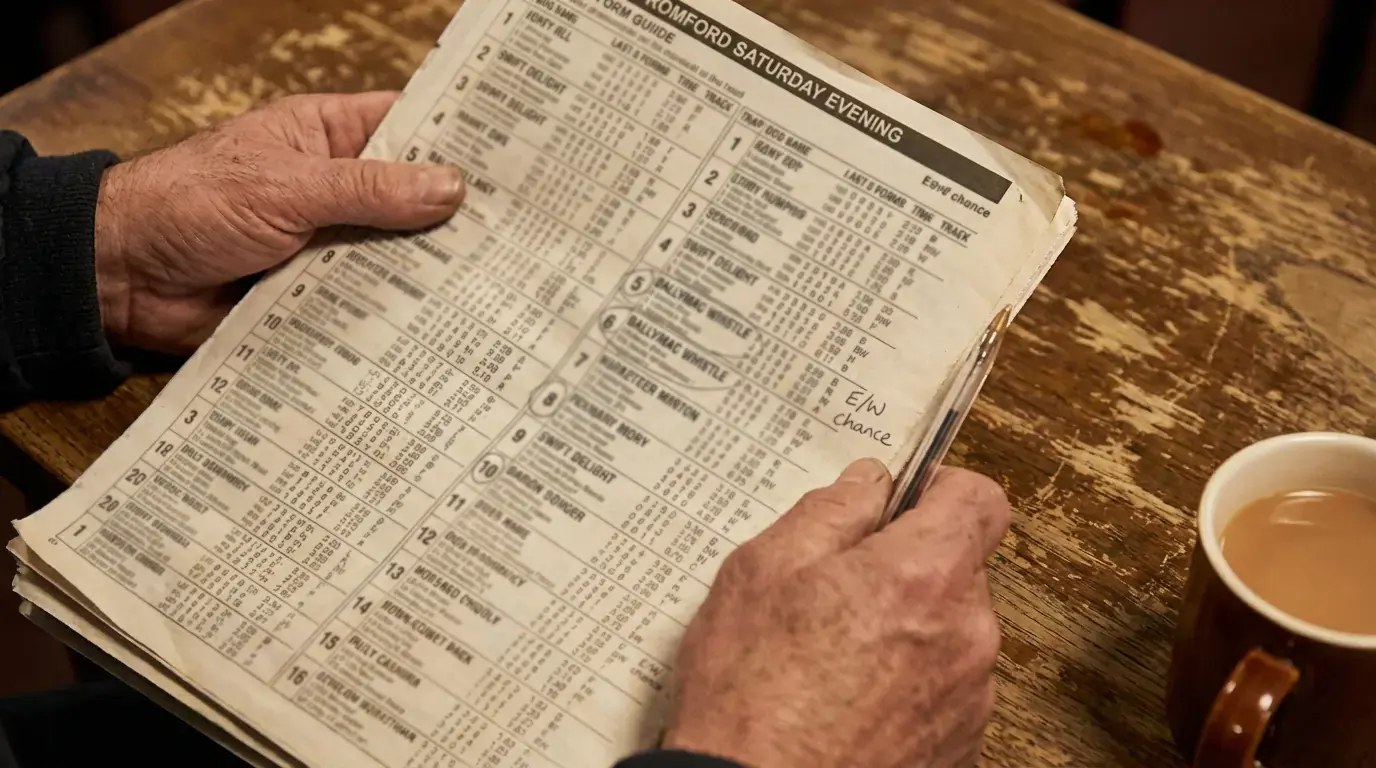
Form is a conversation between data and instinct — learn the language first. In the context of the Greyhound Derby, "form" means the accumulated record of each dog's performances, both within the competition itself and in the lead-up races that preceded it. Derby form is qualitatively different from standard graded race form because the competition structure generates repeated runs at the same track, against progressively stronger opposition, over a compressed timeframe. This gives bettors an unusually rich dataset to work with.
The starting point is the racecard. For each dog in a Derby heat, the card lists recent runs (typically the last six), including finishing position, trap number, time, distance behind the winner, grade of race, and the track at which it ran. For Derby rounds after the first, each dog's performance in earlier rounds is also visible. This within-competition form is the most reliable data you have — it is all on the same track, under the same conditions, against a known field.
What to prioritise when reading Derby form: first, consistency. A dog that has run between 28.60 and 28.80 across three rounds is telling you something more useful than a dog that ran 28.30 once and 29.10 the next time. The Derby rewards dogs that reproduce their performance under pressure. Second, consider how a dog has been running its races — was it leading from the first bend, or closing strongly from the back? At Towcester, early pace is a significant advantage because the run to the first bend is long enough to establish position, and once a dog leads, it has the rail. Third, look at how the dog has handled the bends. Towcester's corners are demanding, and dogs that drift wide lose lengths they rarely recover.
One common analytical error is to over-weight times in isolation. A dog that recorded 28.50 in a first-round heat where it led unchallenged from trap to line has not demonstrated the same thing as a dog that clocked 28.70 while being checked at the first bend and running on strongly to qualify in third. Context matters. The comment line on the racecard — which describes how the race unfolded — is often more informative than the time alone.
Watch out: A single fast time does not make a Derby contender. Dogs run their best times in uncontested leads or on fast-running tracks. Derby finals are rarely uncontested — they are crowded, pressured, and tactically complex. Prioritise dogs that have shown the ability to perform under race pressure, not in time-trial conditions.
Sectional Times and Track Familiarity
A 28.50 at Towcester and a 28.50 at Nottingham are not the same run. Track surfaces, bend profiles, and distances vary across UK venues, which means raw finish times are not directly comparable. For Derby betting, the relevant metric is sectional time — specifically the first-bend split and the run-home time. These tell you how a dog is distributing its effort across the race and, critically, whether it is a pace-maker or a closer.
At Towcester's 500-metre course, the first-bend sectional (the time from trap to the first turn) is a key indicator. Dogs that break quickly and reach the bend in front have a structural advantage: they take the shortest route around the bend and control the race from that point. A first-bend sectional of 4.00–4.10 seconds is competitive at Towcester. Below 4.00 and a dog is genuinely quick out of the boxes — something that can compensate for a less favourable trap draw. The run-home time — from the last bend to the finish line — tells you about finishing stamina and the ability to sustain pace under fatigue.
Track familiarity is another factor unique to the Derby's multi-round structure. Dogs that have raced at Towcester before the competition — in trials or open races earlier in the season — tend to handle the bends better than first-time visitors. The 2026 Derby schedule at Towcester means all six rounds will take place at the same track, giving dogs and trainers multiple weeks to adapt. Bettors should note which dogs are racing at Towcester for the first time and which have established track form there from previous seasons or trial periods.
Trainer and Kennel Patterns
In a race this deep, trainer record is not a tiebreaker — it is the first filter. The English Greyhound Derby has been dominated by a small number of handlers who understand the competition's unique demands: the stamina requirements of multiple rounds, the tactical nuances of Towcester, and the management of a dog's fitness over five weeks of racing.
Charlie Lister OBE holds the record with seven Derby victories, a tally that earned him the title "Derby King." His methods — meticulous preparation, an eye for dogs that peak at the right moment — set the template for modern Derby training. More recently, Graham Holland has emerged as the dominant force, winning the 2022 and 2023 editions with Romeo Magico and Gaytime Nemo respectively. Holland's approach is different: he brings large entries from his Irish base, giving himself multiple shots at the final and creating a scenario where his dogs often race against each other in the heats. In 2025, Holland had three dogs in the final.
Patrick Janssens, based in Thetford, Suffolk, won the 2021 Derby with Thorn Falcon and the 2025 edition with Droopys Plunge — making him the only Belgian-born trainer in Derby history and demonstrating that the competition is not exclusively an Irish or British affair. Liam Dowling, the breeder-trainer behind 2024 champion De Lahdedah, represents the classic Irish one-dog approach: invest everything in a single elite performer and manage its campaign with precision.
For bettors, the practical takeaway is that trainer pedigree matters. A first-time Derby trainer with a fast dog is not the same proposition as a handler who has navigated the competition multiple times. When assessing form, check who trains the dog, how many Derby entries they have in total, and whether they have a history of peaking dogs at the right stage of the competition.
Derby Betting Strategy: What the Data Says
The favourite has lost more Greyhound Derby finals than it has won since 1985. That is not an opinion — it is the record. Since the Derby moved to Wimbledon in 1985, there have been over forty finals, and the market favourite or joint-favourite has won approximately fourteen of them. That translates to a win rate of roughly 34%. Backing every favourite to level stakes across this period would have returned a net loss of approximately £11.46 per £1 staked. The data is clear: blindly following the market leader in the Derby is a losing strategy over time.
The most recent favourite to lose was Bockos Diamond in the 2025 final, sent off at 11/10 after dominating the Irish Derby and posting strong form throughout the English competition. He finished second. Before him, the market leader had also been beaten in 2024, 2023 and 2022. The last winning favourite was Jaytee Jet in 2016, and before that, Taylors Sky in 2011. Two winning favourites in fourteen years is a statistic that should reshape how you approach the final.
This does not mean favourites cannot win. It means the Derby, by nature, is volatile. Six dogs racing at high speed around bends on sand is inherently unpredictable. Early pace, trap draw, the first-bend scramble — all inject randomness that is difficult to model. The implication for bettors is that the Derby rewards a value-based approach rather than a confidence-based one. Instead of asking "which dog will win?", the more productive question is "which dog's odds underestimate its actual chance?"
Sound Derby strategy begins with form analysis, runs through odds comparison, and finishes with staking discipline. The sections above cover form and odds in detail. What follows addresses how to identify value specifically, and how to manage your money across a full Derby night card.
Do
- Compare odds across at least three bookmakers before every bet
- Weight within-competition form over pre-Derby open race form
- Use each-way at prices of 5/1 or longer in the final
- Track sectional times, not just finish times
- Set a total budget for Derby night and stick to it
- Consider the trap draw when finalising selections
Don't
- Back the favourite automatically — the strike rate does not justify it
- Chase losses between heats on the undercard
- Rely on a single fast time as evidence of Derby-winning ability
- Ignore Irish-trained runners — they have won five of the last seven Derbies
- Place your entire budget on the final race alone
- Bet without checking Best Odds Guaranteed availability
Finding Value Beyond the Favourite
Value is not about backing longshots — it is about backing dogs whose price does not match their chance. This distinction matters. A 10/1 shot that you assess as having a 15% chance of winning is better value than a 2/1 favourite that you assess at 30%, because the bookmaker is underpricing the longer-odds dog relative to your assessment of the race. Value betting is not a hunch; it is a comparison between your own probability estimate and the implied probability of the odds.
In the Derby final, value frequently lies with the second and third choices in the betting. These are dogs that have strong form, often from the same elite kennels as the favourite, but are priced longer due to a less fashionable profile or a slightly inferior draw. De Lahdedah, the 2024 champion, was not favourite when he won his first Derby — he was a strong contender at a workable price. Droopys Plunge in 2025 was the sole British-trained finalist, largely overlooked by a market fixated on the Irish contingent.
To find value, build your own race assessment before looking at the odds. Rank the six finalists based on form, sectional times, trap draw, and trainer record. Assign each a rough percentage chance. Then compare your percentages with the implied probabilities from the bookmaker's odds. Where there is a significant gap — your assessment gives a dog a meaningfully higher chance than the odds suggest — you have a potential value bet. Where the odds are shorter than your assessment, the market is already accounting for that dog's strengths, and there may be no edge in backing it.
This approach requires discipline. It will not always produce a winner. But applied consistently across multiple Derbies, it tilts the long-run mathematics in your favour — which is the only thing that ultimately separates profitable betting from gambling.
Bankroll Approach for Derby Night
Derby night is a full card — not a one-race event. Budget accordingly. A typical final-night programme at Towcester features around fifteen races, including the Derby final, the Puppy Trophy, the Sprint Trophy, and several supporting open and graded races. The temptation to bet on every race is real, and it is the fastest way to drain a bankroll before the final even begins.
A practical approach is to allocate a fixed Derby night budget and divide it into units. A common split: 50% reserved for the final itself (outright, each-way, forecast), 30% allocated to specific heats or support races where you have a strong opinion, and 20% held in reserve as a contingency. This structure ensures you still have meaningful stakes available for the main event, even if the earlier races have not gone your way.
Within each bet, flat staking — betting the same unit size regardless of odds — is the safest approach for most punters. It prevents the classic error of increasing stakes after a losing run in an attempt to recover losses (known as chasing). If you are more experienced, a percentage-based model — staking a fixed percentage of your current bankroll on each bet — adjusts naturally to wins and losses. Either way, the principle is the same: no single bet should represent a disproportionate share of your total Derby budget.
One final point on timing. Do not place all your final-race bets in one go. The odds market for the Derby final continues to move right up until the traps open. Watching the earlier races, gauging the track conditions on the night, and noting any late information (such as a dog's behaviour in the parade ring) can all inform last-minute decisions. Keep a portion of your final-race allocation for these race-night adjustments.
Trap Draw and Its Impact on the Final
Trap 1 hugs the rail. Trap 6 has daylight. Both have won finals — but not equally. The trap draw is one of the most debated factors in greyhound racing, and in a Derby final, where the margins between six elite dogs are measured in fractions of a second, it can be the difference between winning and finishing fourth.
At Towcester, the 500-metre trip begins with a long run to the first bend. This straight section is where early pace is established, and the dog that reaches the bend in front typically has the advantage of racing on the inside — the shortest route around the turn. Trap 1, on the rail, gives a natural positional advantage to dogs that break quickly: they have less ground to cover to reach the bend first. Trap 6, on the outside, gives a wider berth and more room to run — beneficial for dogs that need space and tend to drift wide, but a disadvantage if the dog fails to show enough early pace to compensate for the extra distance.
Historical data on Derby finals at Towcester shows no single trap dominates conclusively, but patterns exist. Inside traps (1 and 2) have tended to favour strong early-pace dogs that can hold a tight racing line. Outside traps (5 and 6) have produced winners when occupied by dogs with exceptional early speed or when the inside dogs are slow to break. Middle traps (3 and 4) are often considered neutral — they provide neither the rail advantage nor the outside room, and their success depends heavily on the specific dogs drawn either side.
For bettors, the trap draw should be the final filter in your analysis, not the starting point. If your form analysis identifies a strong contender, check whether the trap draw helps or hinders that assessment. A good dog in a bad draw is still a good dog — but the odds should reflect the draw disadvantage. If they do not, the value has shifted to another runner.
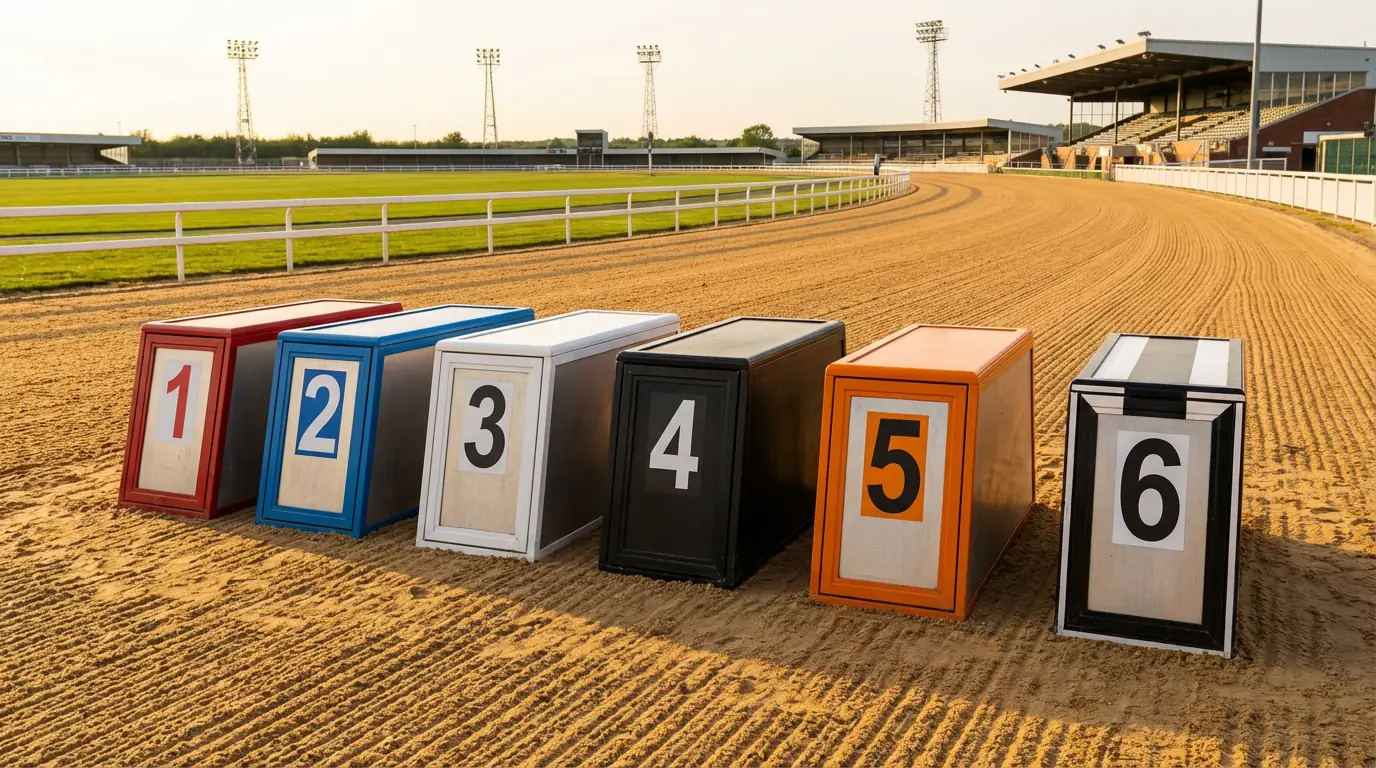
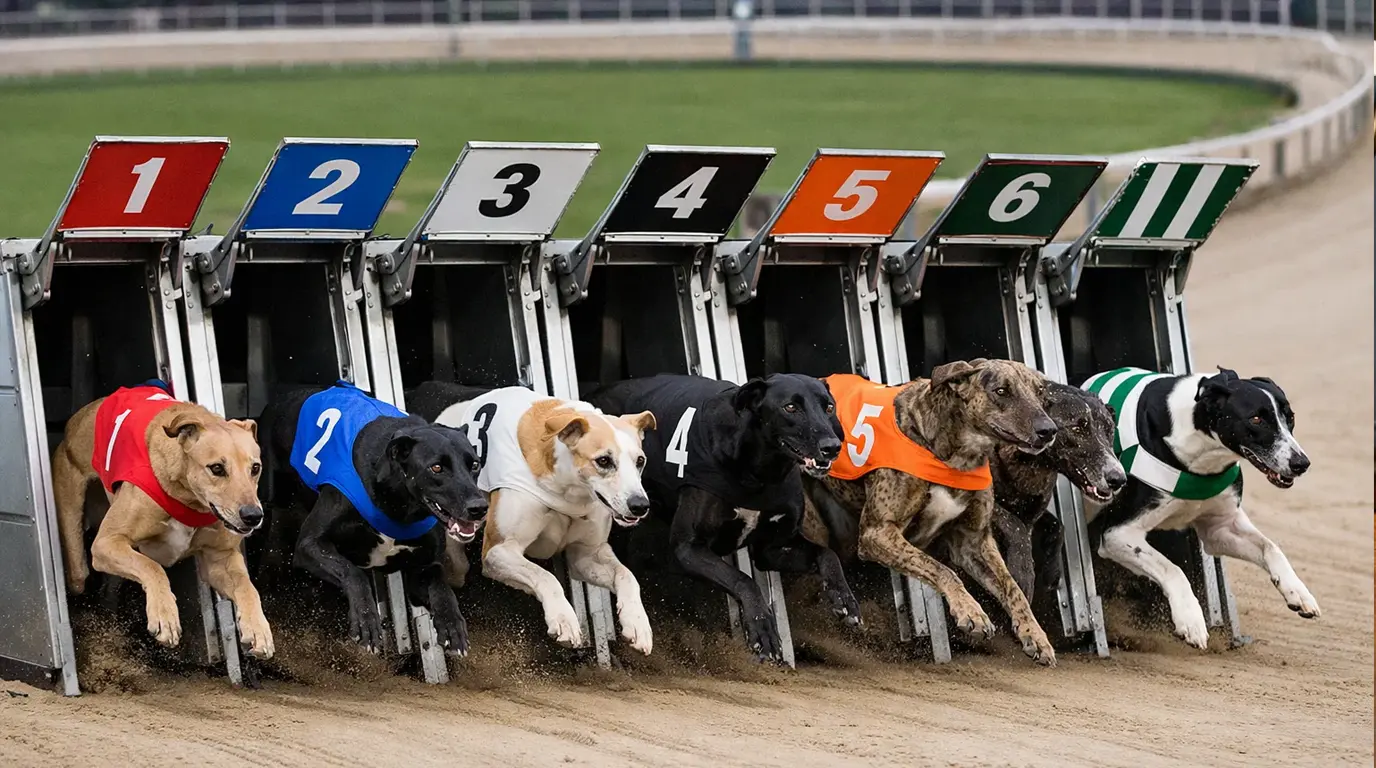
Trap 1 — Red
Rail position. Shortest route to the first bend. Suits strong breakers who hold the inside line through Towcester's bends.
Trap 2 — Blue
Near-side. Benefits from the inside line if trap 1 is slow out. A solid each-way trap for dogs with early pace and clean cornering.
Trap 3 — White
Inner-middle. Neutral draw. Success depends on the dogs either side and the occupant's tactical flexibility.
Trap 4 — Black
Outer-middle. Dogs here need enough pace to avoid being squeezed by runners from both sides through the first turn.
Trap 5 — Orange
Wide draw. Suits dogs that prefer space and have the pace to sit handy on the outside. Difficult for closers.
Trap 6 — Stripes
Widest berth. Maximum daylight, maximum ground to cover. Best for dogs with blistering early speed who can cross before the bend.
A Brief History of the Derby Final
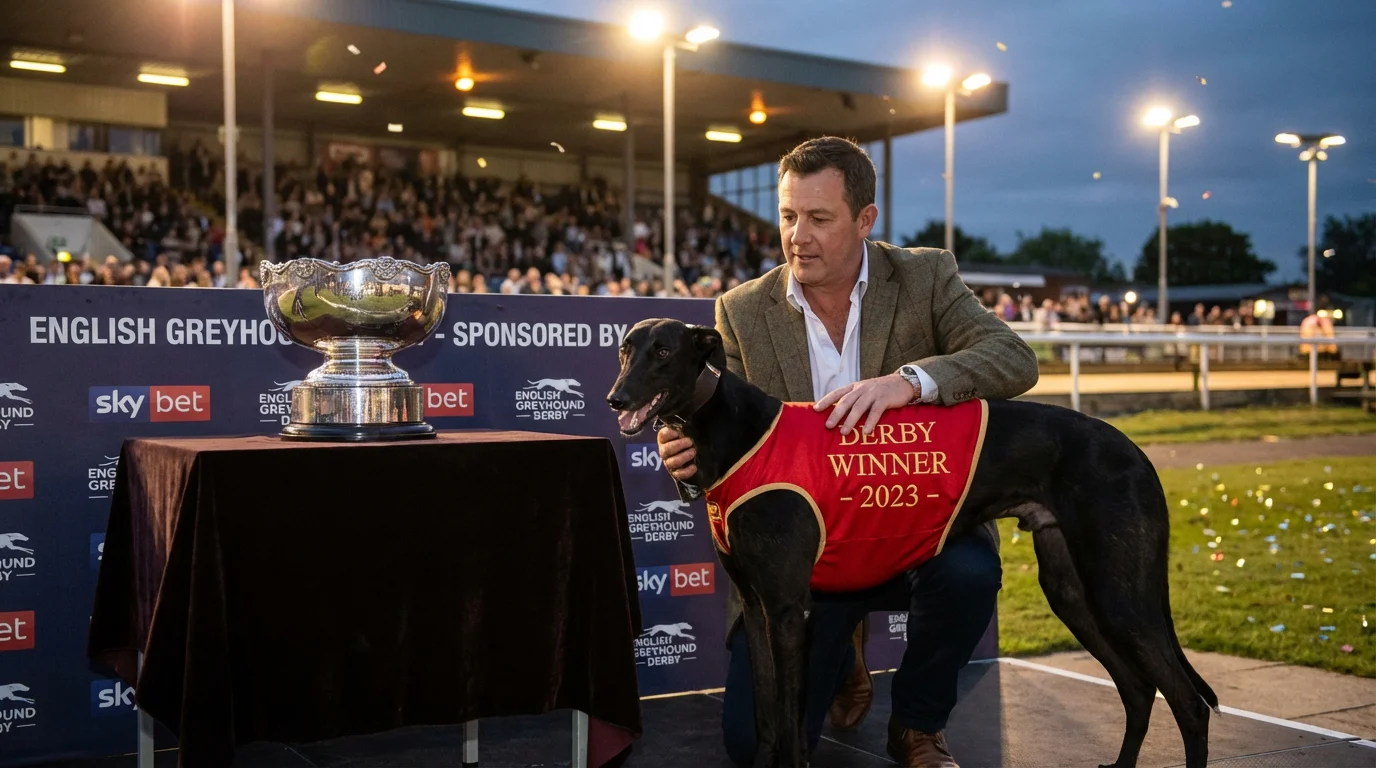
White City, 1927: six dogs and a mechanical hare — the beginning of everything. The English Greyhound Derby was first staged at White City Stadium in London, a venue originally built for the 1908 Summer Olympics. The first winner, Entry Badge, took the prize at odds of 1/4 — a short-priced favourite in a race that had barely existed a fortnight earlier. Greyhound racing had only recently arrived in Britain from the United States, where the oval track and mechanical lure had been invented by Owen Patrick Smith around 1912, with the first commercial track opening in Emeryville, California, in 1919. Within a decade, the Derby had become a national event.
The early years produced the sport's first genuine star: Mick the Miller, who won consecutive Derbies in 1929 and 1930 and became a household name in Britain — he appeared in a feature film and his stuffed body remains on display at the Natural History Museum at Tring. Only three dogs have matched his feat of winning the Derby twice: Patricias Hope in 1972 and 1973, Rapid Ranger in 2000 and 2001, and Westmead Hawk in 2005 and 2006. Defending a Derby title remains one of the rarest achievements in the sport.
White City hosted the final until 1984, when the stadium closed. The Derby moved to Wimbledon Stadium in 1985, beginning a three-decade residence that many fans still consider the race's spiritual home. Wimbledon's 480-metre trip produced some of the most dramatic finals in Derby history, and the stadium's location in south-west London ensured strong attendances. When Wimbledon itself closed in March 2017 — a victim of property development pressures that have shuttered many of Britain's historic greyhound tracks — the Derby moved to Towcester Racecourse in Northamptonshire, where the distance was set at 500 metres on sand.
Towcester's tenure has not been uninterrupted. The track closed temporarily in 2018 following the racecourse's financial difficulties, forcing the 2019 and 2020 Derbies to Nottingham. Since its reopening, Towcester has hosted the Derby continuously from 2021, and the 500-metre sand course has become the established home of the competition. The 2026 edition will be the eighth Towcester final, and with the venue now under stable management, the Derby appears settled for the foreseeable future.
Through all the venue changes, the fundamental character of the race has remained: the most prestigious title in British greyhound racing, awarded to the dog that survives an elimination tournament of unmatched depth. Trainers dream of it. Bettors plan for it months in advance. And every June, it delivers.
Nearly a century of history, and the Derby still produces more questions than answers — three of the most common are addressed below.
Greyhound Derby Final: Frequently Asked Questions
How many rounds does the English Greyhound Derby have, and how does the format work?
The English Greyhound Derby runs over six rounds: first round, second round, third round, quarter-finals, semi-finals, and the final. Approximately 192 dogs enter the first round, split into heats of six. The first three finishers from each heat progress to the next stage. This knockout format continues over roughly five weeks, with one round per week, until six dogs remain for the final. All rounds take place at Towcester Greyhound Stadium over 500 metres on sand. The final is typically held on a Saturday evening in mid-June, with a prize of £175,000 to the winner.
What types of bets can you place on the Greyhound Derby final?
The main bet types for the Derby final are: outright winner (including ante-post bets placed before the final), win (backing a single dog to finish first), each-way (splitting your stake between a win bet and a place bet, typically paying 1/4 odds for places 1-2 in a six-runner field), forecast (predicting the first two finishers in order), and tricast (predicting the first three in order). Reverse and combination versions of forecasts and tricasts are also available. Most UK bookmakers additionally offer specials such as winning trap colour, top trainer, and without-the-favourite markets during the Derby.
Does trap draw really matter in the Greyhound Derby?
Trap draw matters, but it is not decisive on its own. At Towcester's 500m course, the run to the first bend is long enough that early pace is critical — inside traps (1 and 2) offer a shorter path to the rail, benefiting strong breakers, while outside traps (5 and 6) suit dogs with exceptional speed that can cross over before the bend. Historical Derby final data shows no single trap dominates consistently, but odds do shift after the draw is announced, reflecting the perceived advantage or disadvantage for each runner. The draw should inform your assessment, not dictate it.
The 28 Seconds That Define a Season
Every year, the Derby final strips the sport down to its purest form. Five weeks of heats, dozens of races, hundreds of dogs — and all of it collapses into a single 500-metre sprint on a Saturday night in June. The dog that wins may be the favourite or a 33/1 outsider. It may be trained in Ireland or Belgium or Sheffield. It may lead from the traps or close from the back of the pack with a finish that leaves the crowd breathless. The only certainty is that the race will happen, and one of the six will be the fastest around Towcester that night.
For bettors, the Derby final is both the most analysable and the most unpredictable race of the year. The multi-round format hands you more data than any other single greyhound event. Form lines, sectional times, trap draw patterns, trainer records — all of it points toward informed decisions. And yet, the race itself routinely defies the most careful analysis. The best dog does not always win. The best-drawn dog does not always win.
That uncertainty is not a flaw. It is the reason the Derby generates more betting interest than every other British greyhound race combined. And it is why the right approach is not to seek certainty, but to seek edge. Every section of this guide — from format to form to strategy to trap bias — is aimed at the same thing: helping you make decisions that are slightly better informed, slightly more disciplined, and slightly more attuned to where the real value lies. Executed over time, those small advantages matter. They will not guarantee you a winner on Derby night. But they will put you in the position where, when the lids go up and six dogs explode onto the sand, your bet reflects thought rather than hope.
The 2026 Derby at Towcester will unfold across May and June. The ante-post market will open in the spring. Entries will be announced. Heats will be drawn. And once again, six dogs will make the final. Be ready.
