
Betting on the Derby Isn’t Like Betting on a Tuesday Night Card
The Greyhound Derby is a different animal from your average meeting — and your betting approach needs to match. On a routine Tuesday night at Romford or Crayford, you are dealing with graded races, familiar dogs running at their local track, and odds that reflect a market priced with minimal external attention. The Derby operates on different terms entirely. The competition spans multiple weeks, involves dogs from across Britain and Ireland, runs on a specific track with its own characteristics, and attracts a betting handle that dwarfs anything the sport generates on an ordinary night. Find more betting guides at greyhoundderbyfinal.
That matters because the size and structure of the Derby market changes the dynamics of where value sits. On a Tuesday night, the market is relatively thin — a sharp punter with local knowledge can find prices that don’t reflect reality. In the Derby, the market is deeper, better informed, and more efficient. Finding an edge requires more work, not less. You need to understand the available markets, know when to bet relative to the competition’s timeline, and be able to read a racecard with enough fluency to distinguish genuine contenders from dogs that are merely making up the numbers.
This guide covers the practical mechanics of betting on the Greyhound Derby — from the basics of setting up an account through to the specific markets, the step-by-step process of placing a bet, and the strategic question of timing. It is aimed at punters who are either new to greyhound betting entirely or experienced enough with the dogs but approaching the Derby as a specific event for the first time. The Derby rewards preparation, and preparation starts with understanding how the betting works before you study a single dog’s form.
Greyhound Betting Basics: What You Need First
Before you open a racecard, make sure you understand what you are looking at. Greyhound betting in the UK is regulated by the UK Gambling Commission, and all licensed bookmakers accepting bets on the Derby operate under UKGC oversight. This means your deposits are protected, your winnings are paid according to published rules, and you have recourse if something goes wrong. It also means that the Derby is a legitimate, regulated betting event — not a grey-market novelty.
The core structure of greyhound betting is simpler than horse racing. Every Derby race features exactly six runners, drawn from traps numbered one to six. Each trap has a coloured jacket: red for trap one, blue for two, white for three, black for four, orange for five, and striped black-and-white for six. There are no jockeys, no tactics during the race, and no in-running decisions by the dog. Once the lids open, each greyhound runs its own race based on instinct, fitness, and racing line. The absence of human intervention during the race makes the form analysis more data-driven than in horse racing — times, sectional splits, and running lines are the primary currency.
The six-runner field has a direct impact on the maths of betting. In a six-dog race, the average implied probability per runner is approximately 16.7%. Bookmakers build their margin on top of this, typically pricing a six-runner greyhound race at around 115-125% in total — meaning the sum of all implied probabilities exceeds 100% by the bookmaker’s overround. This margin is important to understand because it defines the headwind you are betting against. In the Derby, where market efficiency is higher than in regular graded racing, the margin tends to be tighter, which is good news for punters looking for value.
Setting Up a Betting Account
Any UKGC-licensed bookmaker will accept greyhound bets — but not all of them treat the dogs equally. The major operators like Betfred, William Hill, Paddy Power, bet365, and Coral all cover the Derby comprehensively, with ante-post markets opening weeks before the first heat and full race-by-race betting throughout the competition. Smaller or digital-only bookmakers may offer the final but skip the earlier rounds, which limits your options if you want to bet on the heats.
When choosing a bookmaker for the Derby, two features matter more than the welcome offer. First, check whether they offer Best Odds Guaranteed on greyhounds. BOG means that if you take a price and the starting price is higher, you are paid at the better odds. Not all bookmakers extend BOG to greyhound racing — some restrict it to horse racing only — so this is worth confirming before you place a bet. Second, look for live streaming. Being able to watch the races through your bookmaker’s app or site is a significant advantage for in-play assessment, even if you are not betting in-running.
Account setup is standard: you provide identification for age and identity verification, deposit funds via card or bank transfer, and you are ready to bet. The process typically takes under ten minutes. If you are opening an account specifically for the Derby, do it before the competition starts — verification delays during the heats can lock you out of the ante-post markets at exactly the wrong time.
Reading the Derby Racecard
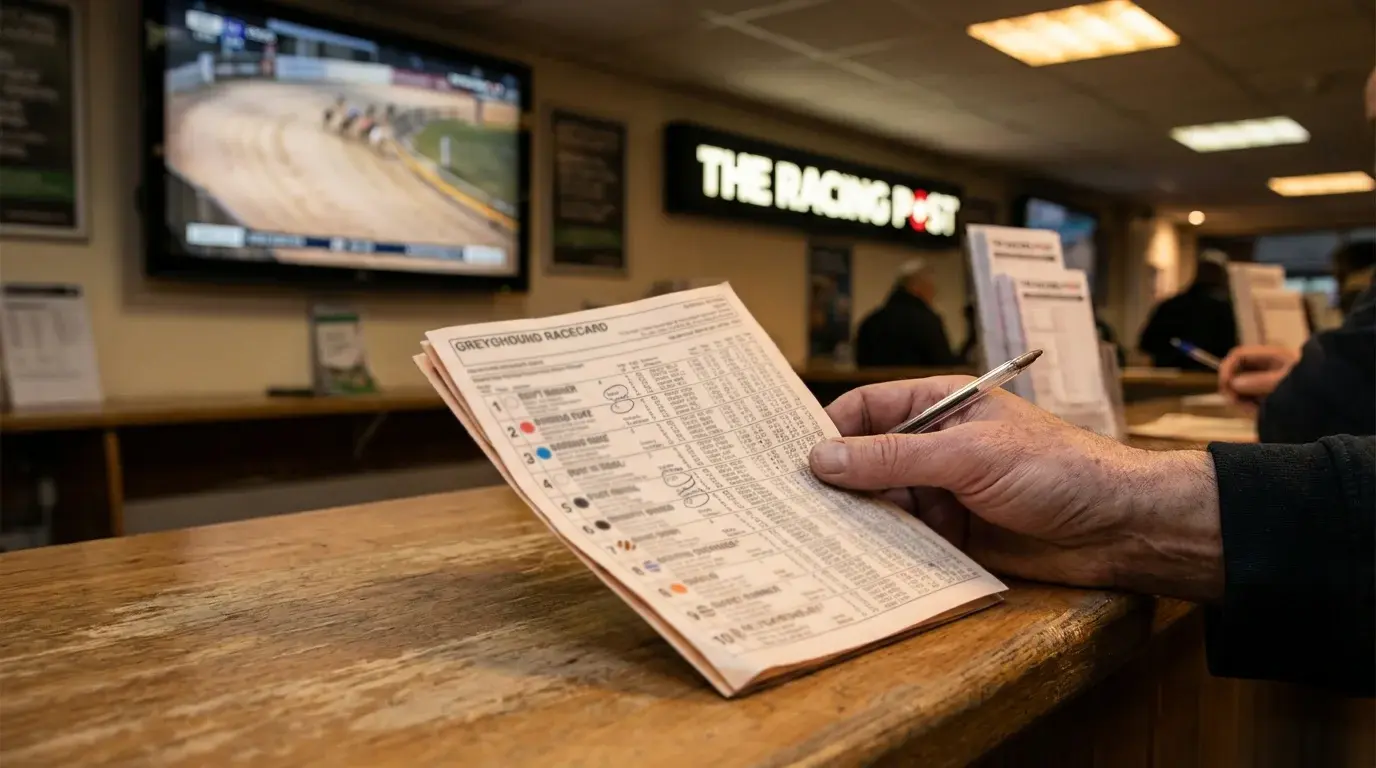
The racecard is your cheat sheet — but only if you know how to read it. A Derby racecard provides the following for each runner: trap number and colour, the dog’s name, trainer, weight, recent form figures, and grade. Form figures are the most important line of data. They read left to right, most recent result first, and record the finishing position in each recent race. A form line of 1-1-2-1 tells you the dog has won three of its last four starts and finished second in the other. A line of 3-5-2-6 tells you something very different.
Beyond form figures, the racecard usually includes the dog’s best time at the track (or a calculated time if trials have been run), its early pace rating, and a comment from the form compiler. Early pace ratings are particularly useful for the Derby because Towcester’s 500-metre course rewards dogs that can find their position quickly out of the traps. A dog rated as a slow beginner from trap six may struggle regardless of its finishing speed.
Derby racecards also note whether the dog is running from its preferred trap position. Some dogs are natural railers — they hug the inside of the track and benefit from lower trap numbers. Others are wide runners who need room and perform better from traps four, five, or six. The trap draw for Derby heats is determined by the GBGB, and it does not always align with each dog’s preferred running style. When a known railer draws trap six, or a wide runner draws trap one, the racecard is giving you information that should influence your assessment of the race.
Spend time with a few racecards before the Derby starts. The Racing Post publishes detailed cards for every round of the competition, and the GBGB website carries official entries and results. Familiarity with the layout means you can extract information quickly on race night, when the time between races is short and the market moves fast.
Every Derby Betting Market Explained
Win, each-way, forecast, tricast, ante-post — each serves a purpose, and none is universally best. The Derby offers the same range of markets as any major greyhound race, but the competition structure means that some markets carry different implications depending on which round you are betting on. Understanding the full menu before the competition starts is not optional — it is the foundation of every decent betting plan.
The Derby markets fall into two broad categories. The first covers bets on individual races — heats, quarter-finals, semi-finals, and the final itself. These are short-form, race-by-race markets where you are betting on the outcome of a single six-dog contest. The second category covers outright bets on the competition as a whole — who will win the Derby — which are priced ante-post weeks or even months in advance. The risk profiles of these two categories are fundamentally different, and treating them interchangeably is one of the most common mistakes casual punters make with the Derby.
Race-by-race markets are resolved on the night. Your dog either wins, places, or doesn’t. The money you commit is at risk for the duration of one 28-second race. Outright markets, by contrast, tie up your stake for the entire competition. Your dog needs to survive every round and win the final. The upside is higher odds; the downside is a longer exposure period during which injury, poor draws, or simple bad luck can eliminate your selection. Both approaches have merit. The question is which suits your risk tolerance and how well you have done your homework.
Win, Place and Each-Way
Start here if you are new — these three cover 90% of what you will need. A win bet is exactly what it sounds like: you back a dog to finish first. If it does, you are paid at the quoted odds multiplied by your stake. If it finishes second through sixth, you lose. There is no safety net, no partial return, and no consolation.
A place bet backs your dog to finish in the top two (in a six-runner field). Place odds are typically one-quarter of the win odds, which means a dog priced at 8/1 to win would pay 2/1 for a place. Place betting is conservative by nature, but in a competitive Derby heat where three or four dogs have a realistic chance of winning, backing a selection for a place at longer odds can offer solid expected value.
Each-way is the combination of both: your stake is split in half, with one half on the win and one half on the place. If your dog wins, you collect on both portions. If it finishes second, you lose the win half but collect the place half. If it finishes third or worse, you lose everything. Each-way is the market that best suits the Derby’s competitive dynamic. Six-runner fields with closely matched dogs produce plenty of results where a good selection finishes second rather than first. Without the each-way safety net, those near-misses are total losses. With it, they return a portion of your stake — and at longer odds, the place portion alone can produce a profit.
The standard each-way terms for a six-runner greyhound race are 1/4 the odds for places one and two. Some bookmakers offer enhanced each-way terms as Derby promotions — typically 1/3 the odds or paying three places instead of two — and these promotions are worth seeking out, because they shift the maths significantly in the punter’s favour.
Forecast, Tricast and Combination Bets
Higher risk, higher reward — and you need to know the maths before you commit. A straight forecast requires you to name the first and second finishers in exact order. Get them both right, in the right sequence, and the payout is substantial — typically calculated by the computer straight forecast formula rather than at fixed odds. Get the order wrong, and the bet loses, even if you identified the right two dogs.
A reverse forecast covers both permutations of your two selections — dog A first and dog B second, or dog B first and dog A second. This doubles your stake but removes the requirement to predict the exact order. In a six-runner Derby race where two dogs appear clearly superior, the reverse forecast is a practical way to back your judgement without needing to split hairs on which of the two finishes ahead.
A tricast requires naming the first three finishers in exact order. The payouts can be dramatic — hundreds or even thousands of pounds from a small stake — but the difficulty is commensurately higher. In a six-runner race, there are 120 possible first-second-third permutations, and the straight tricast asks you to identify exactly one. Combination tricasts cover all permutations of your three selected dogs, which reduces the difficulty but multiplies the stake by six. A £1 combination tricast costs £6.
Forecast and tricast betting suits the punter who has strong opinions about form separation in a particular race. If you believe the Derby heat has two clear standouts and the rest are competing for third, a reverse forecast on the top two gives you a structured way to express that view. If you believe the final has three dogs that will dominate, a combination tricast captures your conviction while managing the order uncertainty. These are not bets for casual interest — they reward the punter who has done genuine form analysis and wants to capitalise on their edge in a way that a simple win bet does not.
Step-by-Step: Placing Your First Derby Bet
From account login to bet confirmation — here is exactly what happens. The process is the same whether you are betting on a first-round heat or the final itself, and whether you are using a desktop site or a mobile app. The differences between bookmakers are cosmetic; the underlying flow is identical.
First, log in to your chosen bookmaker and navigate to the greyhound racing section. During the Derby, most major bookmakers feature the competition prominently — it will usually appear as a highlighted event on the greyhound landing page. Select the specific race you want to bet on. The racecard will display all six runners with their trap numbers, colours, recent form, trainer, and current odds.
Second, decide on your selection and your market. Click on the odds next to your chosen dog to add it to your bet slip. The bet slip — typically a panel on the right side of the screen or a pop-up on mobile — will show your selection and ask you to enter your stake. At this point, you will also choose the bet type: win, each-way, forecast, or tricast. For a straight win bet, simply enter the stake amount. For each-way, tick the each-way option and note that your total outlay doubles — a £5 each-way bet costs £10 total, £5 on the win and £5 on the place.
Third, review the bet slip before confirming. Check the dog’s name, the race, the odds, and the stake. Bookmaker interfaces display the potential return — your stake multiplied by the odds — which is worth confirming against your own calculation. Once you are satisfied, confirm the bet. You will receive an on-screen receipt with a unique bet reference number. Screenshot this or save it — it is your proof of the bet in the event of a dispute.
For ante-post Derby bets, the process is similar but the market looks different. Instead of a race-by-race racecard, you will see a list of all entered dogs with outright odds for winning the competition. The same mechanics apply: click the odds, enter the stake, confirm. The critical distinction is that ante-post bets are typically settled on an all-in basis, meaning if your dog is eliminated in the heats or withdrawn through injury, your stake is lost. There is no Rule 4 deduction or refund. This is the trade-off for the significantly longer odds available in the outright market.
One practical note: on Derby final night, the market can move quickly in the minutes before the race. If you are placing your bet close to the off time, check whether the bookmaker applies best odds guaranteed. If they do, it does not matter if the starting price drifts higher after you place your bet — you will be paid at whichever is better. If they don’t, you may want to wait until the market has settled, which typically happens in the final two or three minutes before the lids open.
When to Bet: Ante-Post vs On-the-Night
The right time to bet depends on what you are willing to risk and what you are chasing. This is not a throwaway line — it is the single most important strategic decision in Derby betting, and getting it wrong can undermine everything else you do right.
Ante-post betting opens weeks before the first heat. At this stage, the field is wide — 192 entries or more — and the bookmakers are pricing dogs based on pre-competition form, trainer reputation, and breeding. The odds are at their most generous, because the uncertainty is at its highest. A dog that will eventually go off at 3/1 in the final might be available at 20/1 or 25/1 in the early ante-post market. The obvious appeal is the price. The equally obvious risk is that your dog might never reach the final. Injury, an unfavourable trap draw in the heats, or simply running into a better dog in the early rounds can end a campaign before it properly starts. Your stake is gone with no return.
The ante-post market sharpens as the competition progresses. After the first round, the field is halved. After the quarter-finals, it is halved again. By the semi-finals, only twelve dogs remain, and the outright market has compressed dramatically. The prices are shorter, but the information available to you is richer — you have seen how each dog has handled the track, the competition pressure, and the specific trap draws it has faced. Betting at the semi-final stage offers a middle ground: better odds than on final night, better information than at the pre-competition ante-post stage.
On-the-night betting is the most conservative approach. You are betting on a single six-dog race where the form is fully visible, the trap draw is known, and the market has had weeks to settle on a price. The odds are the shortest they will be at any point in the competition, but the information is the most complete. For the punter who wants to bet with maximum knowledge and minimum speculation, this is the natural home.
The choice is not binary. Many serious Derby punters use a staged approach. They take an early ante-post position on one or two dogs whose pre-competition form suggests Derby credentials, accept the risk, and then supplement that position with race-by-race bets during the heats and semi-finals. This approach allows you to capture early value while maintaining flexibility to adjust your overall position as the competition unfolds. If your ante-post selection is eliminated, the race-by-race bets provide a way back into the action without having committed your entire Derby budget to a single outright punt.
Whatever timing you choose, the principle is the same: bet when you have an opinion that differs from the market, and only when the odds available compensate you for the risk you are taking. If the ante-post price on a dog you fancy does not meaningfully exceed what you expect it to be on final night, the risk is not justified. If the on-the-night price on the same dog is shorter than your own assessment of its chance warrants, the information advantage you hold by waiting is wasted. Timing is not about superstition or habit — it is about finding the point where your assessment and the market’s price are furthest apart.
The Racecard Closes, the Lids Go Up — Are You Ready?
No amount of preparation guarantees a winner — but preparation is still the point. The Greyhound Derby final will be decided by factors that no form guide, no statistical model, and no amount of trackside observation can fully predict. Six dogs will run the same 500 metres at the same time, and the margins between them will be measured in fractions of a second. A stumble at the first bend. A check in the middle of the pack. A rail position gained or lost. These are the micro-events that determine the outcome, and they are, by definition, unpredictable.
What you can control is the quality of the decisions you make before the race begins. You can learn to read a racecard fluently, so that you extract the maximum information from the minimum scanning time. You can understand the difference between a win bet and an each-way, between a straight forecast and a reverse, and deploy the right market for the right situation. You can make an informed decision about when to bet — early for value, late for certainty, or somewhere in between for a balance of both.
The mechanics covered in this guide are the foundation, not the ceiling. Knowing how to bet is the prerequisite for knowing what to bet on. Form analysis, trap draw study, trainer evaluation, and market comparison all sit on top of this foundation, and each adds a layer of refinement that can improve your strike rate and your long-term returns. None of it matters, though, if you place the wrong type of bet, miss the optimal timing window, or fail to understand the terms under which your money is at risk. Also read our greyhound racing bet types explained.
The Derby gives you six weeks of competition and one night that justifies the whole season. Whether you back a dog in the first ante-post market or wait until the final six are confirmed, the process is the same: study the form, choose your market, time your bet, and accept the result. The dogs will do the rest — twenty-eight seconds of flat-out racing that no amount of analysis can fully tame. That is the appeal. That is the risk. And that, ultimately, is why people keep coming back to bet on the biggest night in greyhound racing.
