
Two Bets in One — and Why That Matters in a Six-Dog Race
Each-way is the safety net that actually pays — if you understand the terms. In a sport where six dogs leave the traps and anything from crowding on the first bend to a slow start can wreck a perfectly researched selection, having a bet that still returns money when your dog finishes second is not a luxury. It’s a structural advantage. Find more bet type guides at greyhoundderbyfinal.
Greyhound racing is particularly well suited to each-way betting because the fields are small and the place terms are generous relative to the number of runners. In a six-dog race — the standard format for a Greyhound Derby heat or final — each-way terms typically pay two places at a quarter of the win odds. That means your selection only needs to finish first or second for you to see a return, and the place portion of your bet is often more valuable than it first appears.
This article breaks down how each-way works in greyhound racing, what the place terms actually mean for your returns, and when the maths favours splitting your stake instead of going all-in on the win.
How Each-Way Bets Work in Greyhound Racing
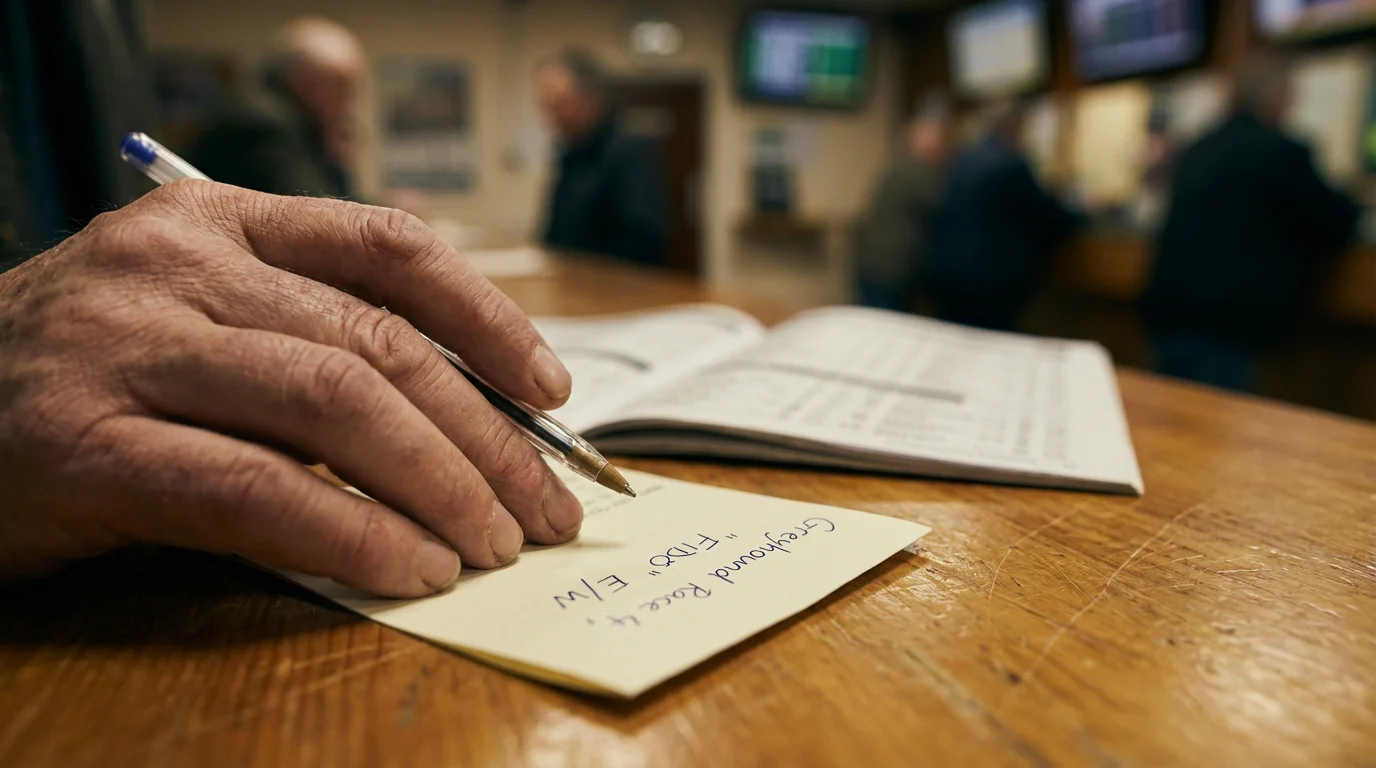
Your stake splits in half — one on the win, one on the place. When you place a £10 each-way bet, you’re actually placing two separate bets of £10 each, for a total outlay of £20. The first £10 is a straight win bet at the full advertised odds. The second £10 is a place bet at a fraction of those odds — typically one quarter in greyhound racing — that pays out if your dog finishes in a place position (first or second in a six-runner race).
If your dog wins, both halves pay out. The win part returns at full odds, and the place part returns at a quarter of those odds. If your dog finishes second, the win part loses, but the place part still pays. If your dog finishes third or worse, both halves lose.
Here’s the arithmetic on a concrete example. You back a dog at 8/1 each-way, staking £10 each way (£20 total). If the dog wins, the win part returns £80 profit plus your £10 stake, and the place part returns £20 profit (8/1 divided by 4 = 2/1, so £10 at 2/1) plus your £10 stake. Total return: £120, for a profit of £100. If the dog finishes second, the win part loses £10, but the place part returns £20 profit plus £10 stake. Total return: £30, for a net profit of £10 on your £20 total outlay.
That second scenario — your selection finishing second rather than first — is where each-way betting earns its reputation. On a straight win bet at 8/1, a second-place finish returns nothing. Each-way turns a losing bet into a small profit. Over a full card of racing, those recovered stakes compound into a meaningful difference in your bottom line.
It’s worth noting that each-way bets are placed at the price available when you make the wager, not at the starting price (unless you specifically choose SP). If your dog drifts from 8/1 to 12/1 before the off, your bet still pays at 8/1. Conversely, if the price shortens, you’ve locked in the better number. This makes early each-way moves particularly attractive when you spot value before the market corrects.
Place Terms for Derby Races
In a six-runner field, the standard terms are 1/4 odds for places 1–2. This is the industry norm across all major UK bookmakers for greyhound racing, and it applies to every Derby heat, quarter-final, semi-final, and the final itself. Unlike horse racing, where place terms vary depending on field size and race type, greyhound each-way terms are remarkably consistent because the field is always six.
The 1/4 odds, two-place structure means that the place portion of your bet always pays at 25% of the win odds. A dog at 4/1 pays 1/1 for a place. A dog at 12/1 pays 3/1. A dog at 20/1 pays 5/1. The maths is straightforward, but the implications are not always obvious — particularly at shorter prices.
Consider a 2/1 favourite. The place odds are 1/2, meaning you need to stake £2 to win £1 on the place portion. If the favourite finishes second, your £10 place bet returns £15 (£5 profit plus £10 stake), but you’ve also lost your £10 win bet. Net result: a loss of £5 on a £20 total outlay. Each-way on a short-priced favourite in a six-dog race is a poor-value proposition because the place fraction doesn’t compensate adequately for the split stake.
At the other end of the spectrum, a 14/1 outsider pays 7/2 for a place. A second-place finish on a £10 each-way bet returns £45 (£35 profit plus £10 stake) from the place leg alone, minus the £10 lost on the win portion, for a net profit of £25. The longer the win price, the more generous the place return — and the more sense each-way makes as a strategy.
Some bookmakers occasionally offer enhanced place terms for the Derby final as a promotional offer — for instance, paying three places instead of two, or boosting the place fraction to 1/3 odds. These promotions change the maths significantly and are almost always worth taking if you were going to bet each-way anyway. Keep an eye on bookmaker specials in the days leading up to the final, because enhanced place terms on a competitive six-dog race can shift the expected value of your bet from negative to positive.
When Each-Way Beats a Straight Win Bet
The maths favours each-way when your selection is priced 5/1 or longer in a competitive field. Below that threshold, the place fraction is too thin to justify splitting your stake — you’re better off either backing the dog to win at full odds or finding a different selection entirely.
The logic is simple. At 5/1 each-way, a second-place finish returns 5/4 on the place portion. Your £10 place bet gives you £12.50 plus your £10 stake back, totalling £22.50. Subtract the £10 lost on the win part, and you’re left with a net profit of £2.50 — enough to cover the cost of the split and leave you marginally ahead. At 4/1, the same calculation produces a net loss on a second-place finish. The breakeven point in a six-runner field with 1/4 odds sits right around 5/1.
Beyond the raw maths, each-way becomes especially attractive in three specific Derby situations. First, when backing a dog with strong place credentials but a question mark over whether it can win outright — perhaps a consistent runner-up type that has finished second in two consecutive heats. The chance of another place finish may be higher than the chance of a win, and each-way captures that.
Second, in the final itself, where the field quality is at its peak and any of the six dogs could realistically finish in the first two. A six-dog field with three or four genuine contenders is the ideal each-way scenario because the place probability is elevated for every runner beyond the outright favourite.
Third, when you’re spreading stakes across multiple races on Derby night. If you’re betting on four or five heats plus the final, each-way on your selections gives you more routes to a return than straight win bets. A night where two of your five selections win and two more finish second is a profitable night on each-way terms but a break-even night — at best — on win-only stakes.
The Quiet Edge of the Each-Way Punter
Each-way won’t make you rich — but it’ll keep you in the game longer. That’s not a minor virtue when you’re betting on a sport where a bump at the first bend can turn a 3/1 favourite into a fourth-place finisher. The punters who consistently show a profit on greyhound racing tend to share one trait: they understand that surviving losing runs is as important as backing winners. Each-way betting is a survival tool.
The approach works best when you treat it as a deliberate strategy rather than a default setting. Don’t back every dog each-way because you can’t decide whether it’ll win. Instead, reserve each-way for the selections where the place probability genuinely exceeds what the implied place odds suggest — the 7/1 shot that you think has a 40% chance of finishing in the top two, for instance. That’s a positive-expectation each-way bet, and those are the ones that compound over time. Also see our greyhound racing bet types explained.
In the context of the Greyhound Derby, where a full night might involve half a dozen competitive races, each-way betting turns a volatile evening into a more manageable one. You’ll still need your analysis to be right more often than not, but you won’t need every call to be perfect. And on Derby night, when the margins between first and second are measured in fractions of a length, that flexibility is worth more than most people realise.
