Odds Are a Language — Learn to Read Them
Every greyhound race starts with a set of numbers next to each dog’s name, and those numbers determine everything — what you stand to win, what the market thinks of each runner’s chances, and where the value might be hiding. For experienced punters, reading odds is second nature. For anyone new to greyhound betting, the different formats and terminology can feel like a foreign language. Find more odds guides at greyhoundderbyfinal.
This article translates that language. It covers the three main odds formats you’ll encounter — fractional, decimal, and American — explains how to convert between them, and breaks down the specific way greyhound racing odds are set and moved. By the end, you’ll know not just what the numbers mean but how to use them to assess whether a bet offers genuine value or just a comfortable-looking price.
Fractional Odds: The UK Standard
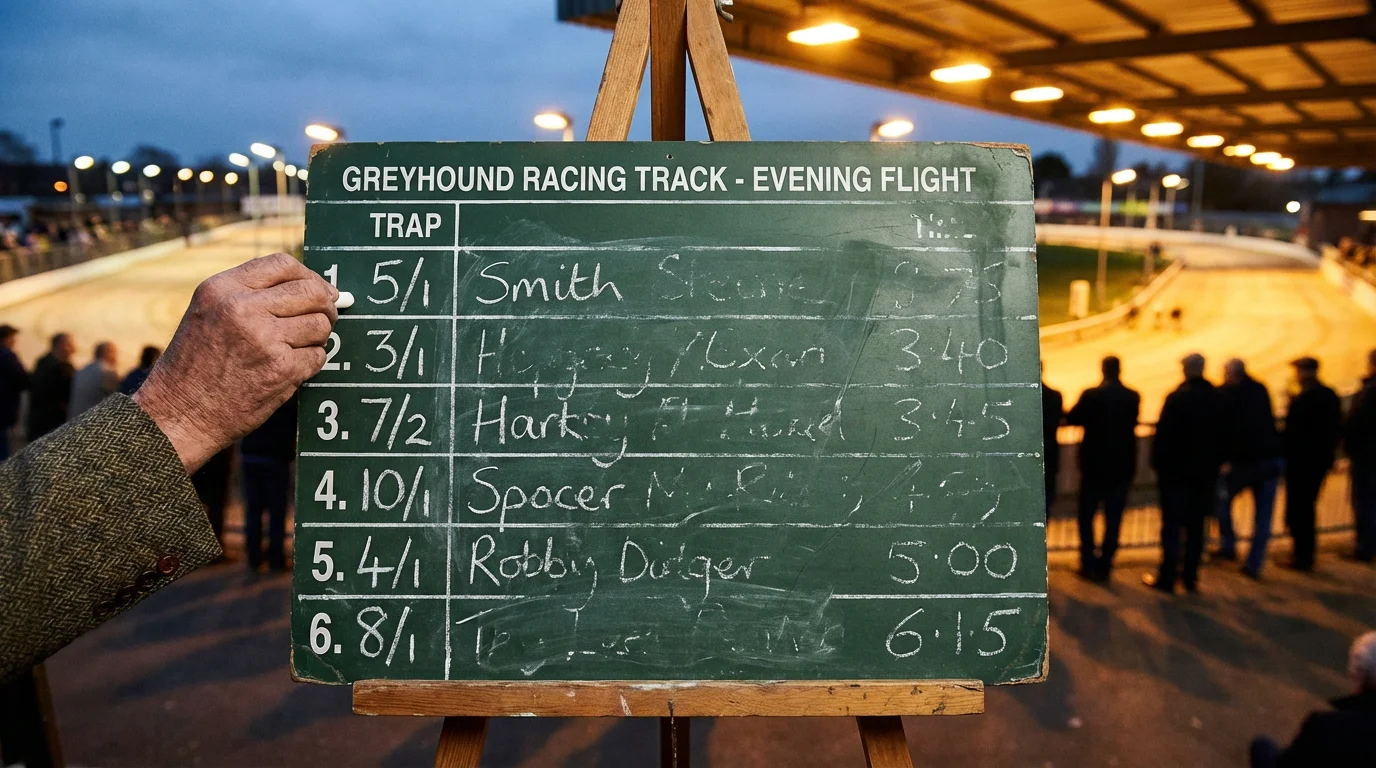
Fractional odds are the traditional format in British betting and the one you’ll see most often on greyhound racecards, in betting shops, and on UK-facing bookmaker sites. They express your potential profit relative to your stake as a ratio. A dog listed at 5/1 (spoken as “five to one”) means that for every £1 you stake, you receive £5 in profit if the dog wins, plus your original £1 back. A £10 bet at 5/1 returns £60: £50 profit plus £10 stake.
The first number represents profit; the second represents stake. At 7/2, you win £7 for every £2 staked — so a £10 bet returns £45 (£35 profit plus £10). At 11/4, you win £11 for every £4 staked, making a £10 bet return £37.50. The arithmetic always follows the same pattern: divide the first number by the second, multiply by your stake, and add the stake back.
Odds-on prices — where the potential profit is less than the stake — are written with the larger number second. A 4/6 shot means you risk £6 to win £4. A £10 bet at 4/6 returns £16.67: £6.67 profit plus your £10 stake. These short prices are common for Derby heat favourites, where a strongly fancied dog in a relatively weak heat might be priced at 1/2 or 4/7.
Fractional odds also carry implied probability — the percentage chance the bookmaker’s price suggests a dog has of winning. To calculate it, divide the second number by the sum of both numbers. At 5/1, the implied probability is 1 divided by 6, or 16.7%. At 2/1, it’s 1 divided by 3, or 33.3%. At 1/2, it’s 2 divided by 3, or 66.7%. These probabilities always sum to more than 100% across all runners in a race — the excess is the bookmaker’s margin, also called the overround.
For Derby betting, understanding implied probability is essential. If you believe a dog has a 25% chance of winning but the bookmaker prices it at 5/1 (implied 16.7%), that’s a value bet — your assessment gives the dog a better chance than the market does. If the same dog is priced at 3/1 (implied 25%), the price exactly matches your assessment and there’s no value. The gap between your probability estimate and the bookmaker’s implied probability is where profitable betting lives.
Decimal and American Odds: The Alternatives
Decimal odds are the standard across continental Europe, Australia, and most online betting exchanges. They represent the total return per £1 staked, including the stake itself. A dog at decimal 6.00 is the same as fractional 5/1 — a £10 bet returns £60. Decimal 3.50 equals 5/2 — a £10 bet returns £35. The conversion from fractional to decimal is straightforward: divide the first number by the second and add 1. So 7/4 becomes (7 ÷ 4) + 1 = 2.75.
The advantage of decimal odds is computational simplicity. To calculate your return, multiply your stake by the decimal price. No separate profit-and-stake arithmetic required. To calculate implied probability, divide 1 by the decimal price: 1 ÷ 6.00 = 16.7%. This makes comparing odds across different bookmakers faster, which is why serious punters often switch their bookmaker display to decimals even if they grew up with fractions.
Decimal odds also make odds-on prices easier to read. A 4/6 fractional shot becomes 1.67 in decimal — it’s immediately clear that your return is less than double your stake, signalling a short-priced favourite. In fractional format, the same information requires a moment’s calculation. When you’re scanning a racecard with six runners and comparing prices across three bookmakers, that moment adds up.
American odds, also called moneyline odds, are primarily used in the United States and will be less relevant for most UK greyhound punters. Positive American odds show the profit from a $100 stake: +500 means $500 profit on a $100 bet (equivalent to 5/1). Negative odds show how much you need to stake to win $100: -150 means you stake $150 to win $100 (equivalent to 2/3 fractional). Unless you’re using a US-facing platform, you’re unlikely to encounter American odds in greyhound racing, but the conversion is useful to know: for positive odds, divide by 100 and you have the fractional first number with 1 as the second. For negative odds, divide 100 by the absolute value.
Starting Price, Board Price, and How Greyhound Odds Are Set
Greyhound racing odds originate differently from horse racing odds, and the distinction matters for your betting. In horse racing, the starting price (SP) is determined by on-course bookmakers at the track. In greyhound racing, where on-course bookmaking is far less prevalent, the SP is typically set by the industry SP service using a combination of bookmaker prices and algorithmic inputs. The result is a standardised starting price declared after the race that applies to all SP bets.
The board price — the odds displayed on a bookmaker’s website or app before the race — is the price available at the time you place your bet. If you take the board price, that’s the price you’re locked in at, regardless of what happens to the market between your bet and the off. If the price shortens after you’ve taken it, you’ve secured value. If it drifts longer, you’ve accepted a lower price than what turned out to be available at the off. This is where Best Odds Guaranteed becomes relevant: if your bookmaker offers BOG, you receive the SP if it’s higher than the board price you took, eliminating the downside of betting early.
Understanding how greyhound odds are set helps you identify when prices are likely to move. Bookmakers initially price a six-dog race based on form ratings, trap draw, and recent times. These opening prices are provisional and often appear in the morning for evening meetings. As money comes in from punters, the bookmaker adjusts — shortening the price on popular selections to manage liability and drifting the prices of less-backed dogs to balance the book.
In a Derby final, this process is more compressed and more volatile than a standard meeting. The public interest is higher, the amount of money flowing through the market is larger, and the price movements between the morning and the off can be dramatic. It’s not unusual for a Derby finalist’s odds to halve between the morning show and the start of the race if a significant volume of money arrives on one dog. Conversely, a runner that attracts little support can drift from 5/1 to 8/1 in the same period.
For punters, the practical takeaway is that timing matters. If you have a strong opinion, taking the board price early locks in your position before the market moves. If you prefer to wait and see how the money flows, you gain information but risk paying a shorter price. Neither approach is universally better — it depends on your confidence level and whether you have access to BOG. What you should never do is assume the morning price will still be there at the off. In a Greyhound Derby final, it almost certainly won’t.
Odds Are a Tool — Use Them Like One
The numbers next to a dog’s name are not predictions — they’re a reflection of where the money is and what the bookmaker needs to balance the book. Learning to read them accurately, convert between formats without hesitation, and extract implied probabilities gives you the foundation for every betting decision you’ll ever make on greyhound racing. Also explore our greyhound Derby odds: how to read & find value.
The next step is using that foundation actively. Before any Derby bet, convert the price to implied probability and compare it against your own assessment. If the bookmaker says 14%, and you say 25%, you have a value bet. If the numbers align, you don’t. That single comparison — repeated consistently across every wager — is the difference between punting with an edge and punting on instinct.
Whatever format you prefer, make sure you can work in it fluently. Switch your bookmaker display to decimals if the maths comes easier. Keep fractions if you think in ratios. The format doesn’t matter. What matters is that you understand what the price is telling you and, more importantly, what it isn’t.
