
The Derby’s Home — and What You Need to Know Before You Go
Towcester Greyhound Stadium has been the home of the English Greyhound Derby since 2017, taking over from Wimbledon after decades of south London tradition gave way to property development. The transition was not without turbulence — Towcester itself entered administration in 2018 before reopening — but the venue has since established itself as the permanent base for British greyhound racing’s biggest event.
Whether you’re planning to attend Derby night in person or studying the track from a betting perspective, Towcester’s characteristics matter. This guide covers the practical details — how to get there, what to expect on arrival — and the technical breakdown of a 500-metre sand course that races differently from anything the Derby encountered at its previous homes. Find more track guides at greyhoundderbyfinal.
Location, Getting There, and Parking
Towcester Greyhound Stadium sits on the A5 in Northamptonshire, roughly eleven miles south-west of Northampton and about seventy miles north-west of central London. The postcode is NN12 6LB. It shares its site with Towcester Racecourse, the horse racing venue, which gives it better infrastructure than most standalone greyhound tracks — but the rural location means public transport options are limited.
By car, the stadium is accessible from the M1 (junction 15A, then A43 and A5) or the M40 (junction 10, then A43 north). Journey time from London is roughly ninety minutes outside rush hour, though Derby night traffic around the A5 approach can add delay if you arrive close to the first race. Free on-site parking is available with capacity for several hundred vehicles, and the car park is adjacent to the stadium entrance — no long walk required.
By train, the nearest station is Northampton, served by London Northwestern Railway from London Euston with a journey time of around an hour. From Northampton station, you’ll need a taxi or pre-arranged transport for the remaining eleven-mile leg to Towcester. There is no dedicated shuttle service on regular race nights, though special transport arrangements sometimes operate for Derby finals — check the GBGB or stadium website in the weeks before the event.
For visitors driving from the Midlands or the North, the M1 southbound to junction 15A is the most direct route. From the West, the M40 and A43 corridor brings you in from the south side. Whichever direction you’re coming from, plan to arrive at least forty-five minutes before the first race if you want to settle in, check the racecard, and place your early bets without rushing.
Facilities and the Race-Night Experience
Towcester’s facilities reflect its dual identity as a horse and greyhound racing venue. The main grandstand offers covered viewing with a clear sightline down the home straight and across to the far bends. On standard race nights, the atmosphere is relaxed and relatively low-key — a few hundred attendees spread across the stand and trackside areas. Derby night is a different proposition entirely, with significantly higher attendance, a more charged atmosphere, and the kind of buzz that only the sport’s flagship event generates.
The on-site restaurant offers a seated dining option with trackside views, typically requiring advance booking for Derby night. For a more casual experience, the bar and fast-food outlets serve throughout the evening. Prices are standard for a sporting venue — not cheap, not extortionate. If you’re planning a full evening rather than a quick visit, the restaurant package is worth considering because it gives you a guaranteed seat, a meal, and a base for the night rather than standing trackside for four hours.
Betting facilities on-site include tote windows and, on major nights, bookmaker pitches inside the stadium. The tote operates pool betting — your returns depend on the total pool and the number of winning tickets rather than fixed odds — while the on-course bookmakers offer fixed prices that may differ from what’s available online. For most punters, having a mobile phone with your bookmaker app running alongside the on-course options gives you the best of both worlds: the atmosphere of being there with the price comparison of digital betting.
One practical note: mobile signal at Towcester can be patchy depending on your network, particularly on busy nights when several thousand people are connected simultaneously. If you’re relying on your phone to place bets or stream commentary, test the signal early in the evening and have a backup plan — either a pre-loaded account on the tote or a willingness to use the on-course bookmakers.
The Track: 500 Metres of Sand and What It Means for Betting
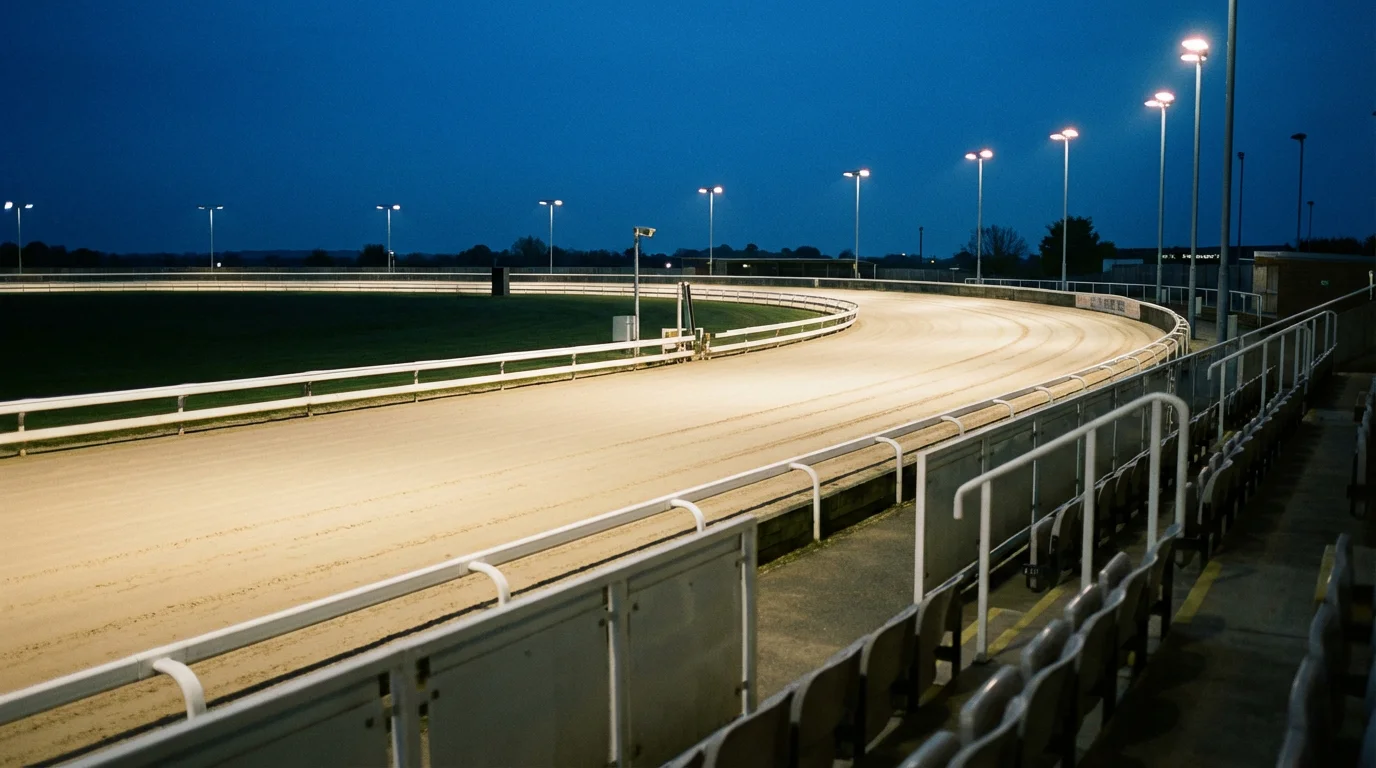
Towcester’s greyhound circuit is a 500-metre sand track — the only major sand-surface track to have hosted the Derby. Wimbledon ran on a hare-and-track system over 480 metres on a different surface profile, and the comparison between the two venues is where most misunderstandings about modern Derby form begin.
The sand surface produces slower absolute times than the tracks the Derby previously used. A winning time of 29.20 at Towcester is a strong performance; the same clock at Wimbledon would have been middling at best. This difference is not about the dogs being slower — it’s about the surface absorbing more energy with each stride. Sand demands greater stamina and sustained drive through the bends, which favours dogs with physical strength and endurance over pure sprinters who excel on firmer going.
The bends at Towcester are wider than those at Wimbledon or Nottingham, which has two consequences for betting. First, the inside-trap advantage is reduced. At Wimbledon, a tight first bend heavily favoured railers from traps one and two. At Towcester, middle draws in traps three and four gain more room to find a position, and the inside rail is less of a guaranteed highway. Second, the wider bends penalise dogs that drift outwards under pressure — a wide runner loses more ground per bend at Towcester than it would on a tighter circuit, making running style a critical variable in form assessment.
The run to the first bend is roughly 90 metres from the traps, giving dogs a reasonable distance to establish position before the field compresses into the turn. This suits dogs with clean early pace but punishes those that are slow out of the boxes and need to recover ground before the bend arrives. In Derby finals, where all six dogs are elite-level runners, that first-bend scramble is typically more competitive than in standard meetings — and the dog that emerges with a clear line through the first turn has a significant structural advantage for the remaining 400 metres.
Track conditions vary with weather. Heavy rain softens the sand and slows times further; a dry, warm evening produces the fastest surfaces. The stadium’s drainage system handles routine rainfall adequately, but persistent heavy weather can produce genuinely testing conditions that alter the form picture. If you’re betting on a Derby heat or final, checking the weather forecast and recent track reports is not optional — it’s part of the analysis. The GBGB website and racing press typically report going descriptions before major meetings.
Towcester Isn’t White City — But It Doesn’t Need to Be
The nostalgia for White City and Wimbledon is understandable — those venues hosted the Derby during its most visible decades, and the atmosphere of a packed south London stadium on final night was something special. Towcester offers a different experience: smaller, more rural, more intimate. What it lacks in urban scale, it compensates for with a purpose-built track that tests greyhounds more comprehensively than either of its predecessors.
For bettors, the venue change matters because the form profiles that succeed at Towcester are different from those that thrived at Wimbledon. Stamina, early pace on sand, and the ability to handle wider bends are all weighted more heavily in the current era. If you’re studying Derby form, you need to study Towcester form specifically — not historical trends from tracks that no longer host the competition. Also explore our greyhound Derby format and Towcester track guide.
And if you’re attending in person, the advice is simple: drive, arrive early, book the restaurant if you want comfort, carry cash for the tote as a backup, and enjoy the fact that you’re watching the biggest night in greyhound racing from fifty metres away rather than through a screen. Derby night at Towcester is a proper sporting occasion. It just happens to be set in the Northamptonshire countryside instead of SW19.
