
Every Term You’ll Encounter on Derby Night — Defined
Greyhound racing and its betting markets use a vocabulary that blends racing jargon, betting terminology, and abbreviations that can be impenetrable to newcomers. This glossary collects every term you’re likely to encounter when reading Derby coverage, studying racecards, or placing bets — from “accumulator” to “wide runner,” with everything in between. Find more Derby guides at greyhoundderbyfinal.
Use it as a reference. If a term appears on your racecard, in a racing column, or on a bookmaker’s site and you’re not sure what it means, this is the page to come back to.
A to F
Accumulator (Acca): A single bet combining selections from multiple races, where winnings from each leg roll into the next. All selections must win for the bet to pay out.
All-In: An ante-post betting rule where your stake is lost if your selection does not start in the race, with no refund. Standard for Derby outright markets before the final field is confirmed.
Ante-Post: A bet placed before the day of the race, often weeks or months in advance. Ante-post prices are typically longer than on-the-day prices but carry additional risk, including the all-in rule.
Best Odds Guaranteed (BOG): A bookmaker promotion that pays the higher of your taken price or the starting price if the SP is greater. Eliminates the downside of betting early.
Board Price: The odds displayed by a bookmaker before the race. Taking the board price locks in that price for your bet, subject to BOG if applicable.
Bump (Bmp): A racecard comment indicating that a dog was physically collided with by another runner during the race, disrupting its stride.
Closer: A dog whose running style involves starting towards the rear and finishing strongly through the final straight. Identified by moderate first-bend splits and quick run-home times.
Combination Forecast: A forecast bet covering all possible finishing orders of three or more selected dogs. Three dogs produce six permutations; four produce twelve.
Crowded (Crd): A racecard comment indicating that a dog was squeezed or impeded by surrounding runners, usually at a bend.
Derby: The English Greyhound Derby, the most prestigious race in UK greyhound racing, held annually at Towcester over 500 metres.
Double: An accumulator with two legs. Both selections must win.
Draw: The trap position assigned to each dog for a race. Trap 1 is on the inside rail; trap 6 is the widest.
Drift: A price movement where a dog’s odds lengthen (become bigger). A drift from 3/1 to 5/1 indicates less money being placed on that selection.
Each-Way (E/W): A bet consisting of two equal parts: a win bet at full odds and a place bet at a fraction of the odds (typically 1/4 in greyhound racing for the first two places).
Early Pace (EP): A racecard comment indicating that a dog showed speed out of the traps in its previous run.
First-Bend Split: The sectional time from the traps to the first bend. Measures early pace and trap-break speed.
Forecast: A bet predicting the first two finishers in exact order. Returns are calculated after the race based on starting prices.
Front Runner: A dog whose racing style is to lead from the traps, setting the pace through the first bend and attempting to maintain the lead throughout.
G to O
GBGB: The Greyhound Board of Great Britain, the governing body for licensed greyhound racing in the UK. Responsible for regulation, welfare, and race integrity.
Going: The condition of the track surface, described in terms ranging from “fast” (dry, firm) through “standard” to “slow” (wet, heavy). Affects race times and can favour different running styles.
Grade: A classification assigned to a greyhound based on its recent performance, determining which races it can enter. Lower numbers (A1, A2) indicate higher quality; Open class sits above the graded structure.
Handicap: A race where dogs start from staggered trap positions based on ability, designed to produce closer finishes. Not used in the Derby, which is a scratch (level start) competition.
Heat: An individual round of a knockout competition. Derby heats determine which dogs progress to the next stage.
Implied Probability: The percentage chance of winning that a set of odds represents. Calculated by dividing the stake portion of fractional odds by the total (e.g., 5/1 = 1/6 = 16.7%).
Knockout: A competition format where dogs are eliminated in successive rounds. The Derby uses a knockout structure from first-round heats to the six-dog final.
Led (Ld): A racecard comment indicating the dog led at some point during its previous race.
Middle Runner (Mid): A dog that races through the middle of the track, neither hugging the inside rail nor running wide. Tactically flexible.
Odds-On: A price shorter than evens, meaning the potential profit is less than the stake. Written as 4/6, 1/2, etc.
Open Race: A race not restricted by grade. The Derby is an Open event, attracting the best dogs from across the UK and Ireland.
Overround: The bookmaker’s built-in margin. The sum of implied probabilities for all runners exceeds 100%; the excess is the bookmaker’s theoretical profit.
P to Z
Place: Finishing in the top two positions in a standard six-dog greyhound race. The place portion of an each-way bet pays out if your selection finishes first or second.
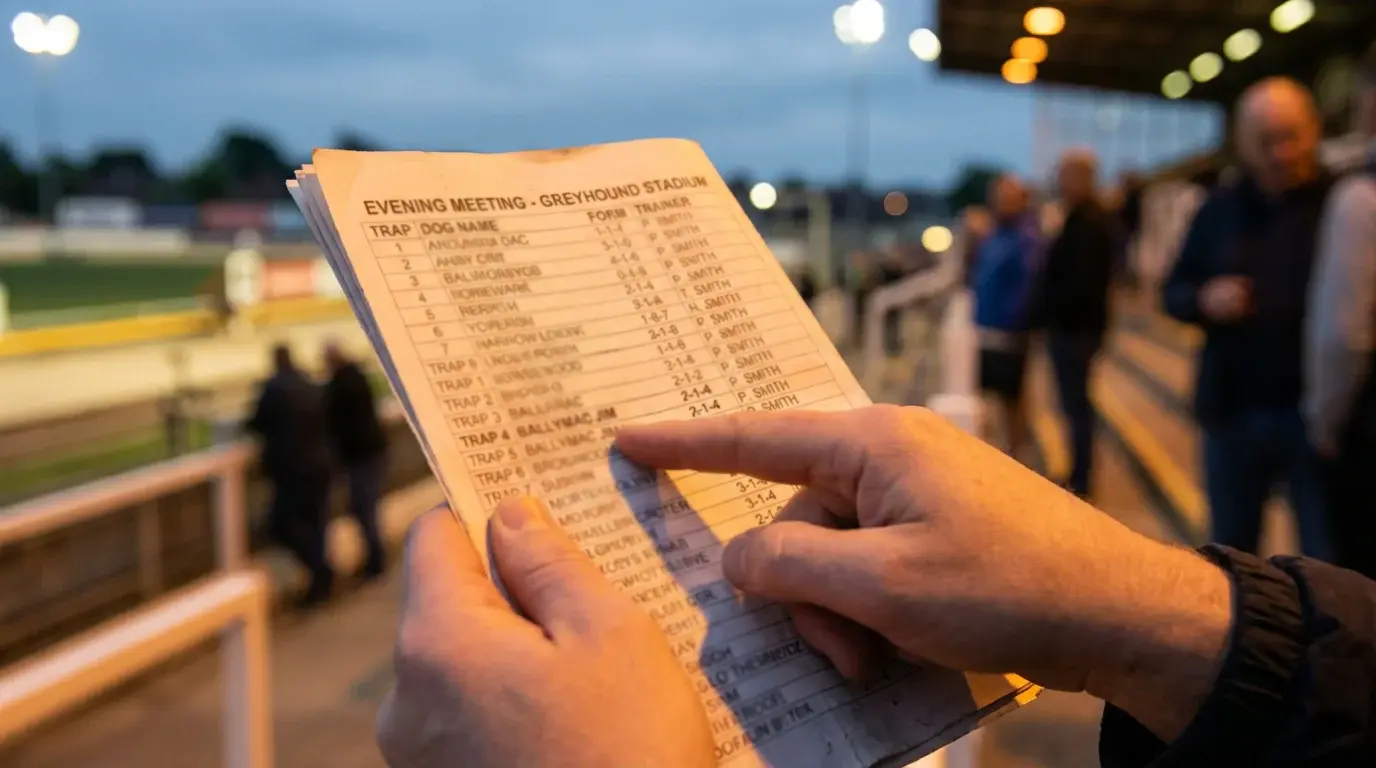
Racecard: The published information for a race, including each dog’s name, trap number, form figures, recent times, weight, trainer, and running comments.
Railer (RIs): A dog that gravitates towards the inside rail through the bends, taking the shortest path around the track. “RIs” in race comments stands for “raced inside.”
Reverse Forecast: A forecast bet covering both possible orderings of two selected dogs. Costs double the unit stake of a straight forecast.
Rule 4: A standardised deduction applied to winning bet payouts when a runner is withdrawn from a race after the market has been formed. The deduction percentage is determined by the withdrawn dog’s price.
Run-Home Time: The sectional time from the final bend to the finishing line. Measures finishing speed and identifies closers.
Running Line: A sequence of numbers describing a dog’s position at key points in a race (e.g., “2-1-1-1” means second at the first bend, then led to the finish).
Scratch: A level-start race where all dogs begin from the same line. The Derby is a scratch competition.
Sectional Time: A timed split covering a portion of the race rather than the full distance. Typically includes first-bend split and run-home time.
SIS (Satellite Information Services): The company that provides broadcast and data feeds for UK greyhound racing, supplying live video to bookmakers and betting shops.
Slow Away (SAw): A racecard comment indicating the dog was slow to leave the traps, losing early position.
SP (Starting Price): The officially declared price of a dog at the time the race begins, set by the industry SP service for greyhound racing.
Straight Forecast: A forecast bet on the first two finishers in exact order. If the two dogs finish in the reverse order, the bet loses.
Tote: The pool betting operator at greyhound tracks. Tote returns depend on the total pool and the number of winning tickets rather than fixed odds.
Trap: The starting box from which a greyhound begins a race. Numbered 1 (inside) to 6 (outside), with corresponding coloured jackets.
Treble: An accumulator with three legs. All three must win.
Tricast: A bet predicting the first three finishers in exact order. In a six-dog race, there are 120 possible tricast permutations.
Value Bet: A bet where the odds offered exceed the true probability of the outcome. Identified by comparing your own probability assessment against the bookmaker’s implied probability.
Wide Runner (RW): A dog that races on the outside of the track. Covers more ground but avoids rail congestion. “RW” in comments stands for “raced wide.”
Without the Favourite: A betting market that removes the market leader and asks which of the remaining runners finishes first. Also read our greyhound racing bet types explained.
Keep This Page Open on Derby Night
The glossary above covers the terms that appear most frequently in Derby coverage, racecards, and bookmaker platforms. Greyhound racing’s vocabulary is compact — once you know these definitions, you can read any racecard, follow any commentary, and understand any betting market the sport offers. Bookmark it, refer back when needed, and let the language stop being a barrier between you and the form.
