Best Greyhound Betting Sites – Bet on Greyhounds in 2026
Loading...
Every Dog Runs Its Own Race — Learn the Vocabulary
Greyhounds are not interchangeable. Some hug the rail from trap to line. Others drift wide through every bend. Some explode from the boxes and build an unassailable lead in the first fifty metres. Others start slowly and close through the field with a finishing kick. These aren’t random variations — they’re consistent behavioural patterns that define how a dog races and, critically, how it interacts with the other five dogs in the field.
Understanding running styles is essential for any bet that goes beyond picking the fastest dog on paper. In a six-runner Greyhound Derby final, where the margin between first and fourth can be less than a length, the interaction between running styles often determines the finishing order more decisively than raw speed. This article maps out the main style categories and explains how to use them when assessing a race.
Railers: The Inside-Line Specialists
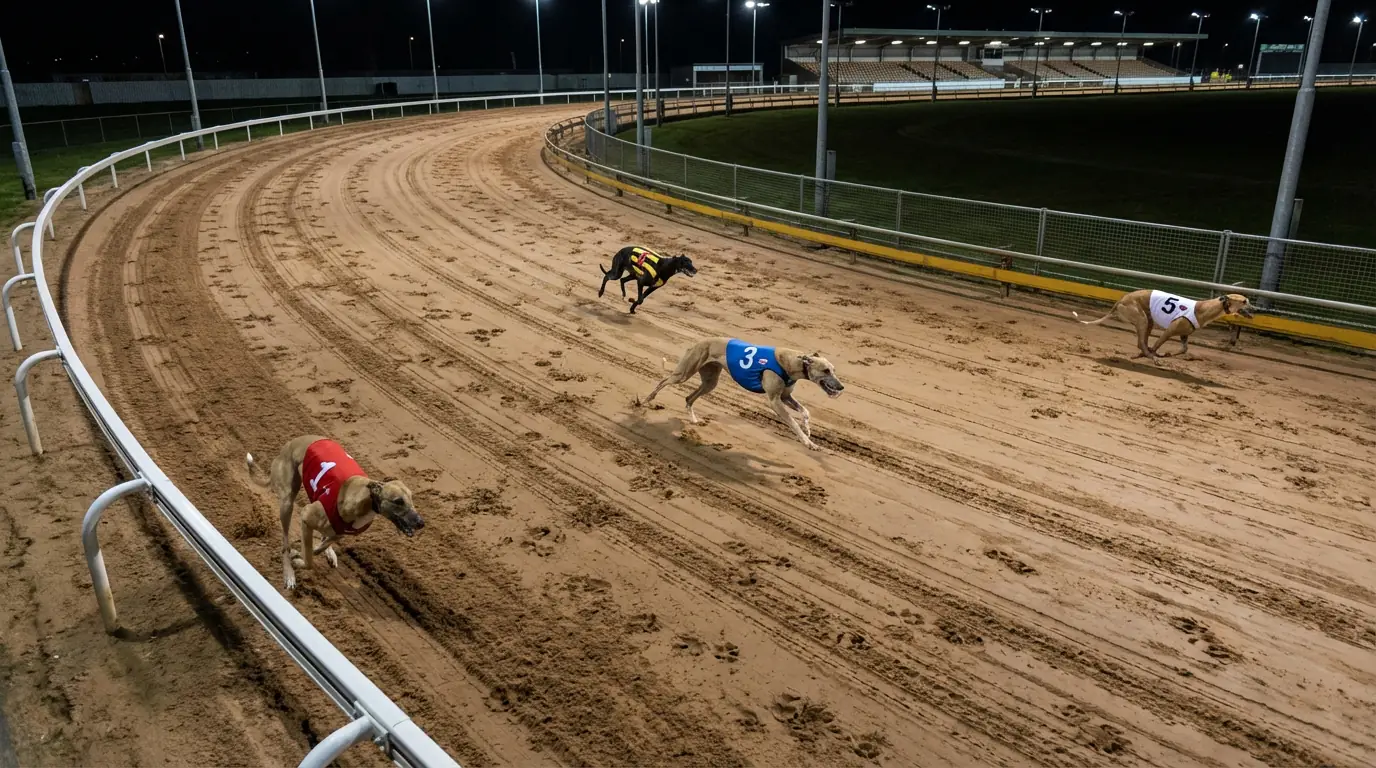
A railer is a dog that naturally gravitates towards the inside rail through the bends, taking the shortest available path around the track. This is the most efficient racing line — the inside route covers less ground than any other — and railers that execute it cleanly have a structural distance advantage over every other dog in the field. On a 500-metre circuit like Towcester, the difference between running on the rail and running two or three lanes wide can amount to several metres over four bends. At greyhound speeds, several metres equals several lengths.
The ideal scenario for a railer is a low trap draw — trap one or two — with clean early pace to claim the inside line before the first bend. When everything aligns, a railer drawn inside can lead into the first turn, hold the rail through every subsequent bend, and win without ever being headed. It’s the most economical way to win a greyhound race, and it’s why form analysts pay close attention to a dog’s rail-seeking tendency.
The vulnerability is crowding. If two or three dogs converge on the inside line simultaneously — common when multiple railers are drawn in adjacent traps — the resulting traffic jam costs all of them ground and momentum. A railer drawn in trap three or four faces a tactical dilemma: aim for the rail and risk getting caught in congestion, or accept a wider line and sacrifice the efficiency advantage that defines its running style. How a railer resolves that dilemma under pressure is often the difference between a Derby finalist and a Derby winner.
On the racecard, railers are typically identified by running comments like “RIs” (raced inside) and running lines showing early prominent positions from inside draws. If the same dog shows a very different running line when drawn wide — finishing further back, racing wider — it may be a one-dimensional railer that depends on the draw rather than a genuinely adaptable runner.
Wide Runners and Middle Runners
Wide runners race on the outside of the track through the bends, taking a longer path but avoiding the congestion that frequently develops on the rail. This style covers more ground — a pure wide runner might travel five to ten metres further than a railer over a full 500-metre race — but it compensates with cleaner running and fewer interruptions. A wide runner rarely gets crowded because there is no dog outside it to cause interference.
The trade-off is distance, and at Towcester, where the bends are wider than at most UK tracks, running wide costs more than it does on a tighter circuit. A wide runner needs genuine stamina and sustained speed to offset the extra ground. Dogs that fade in the final 100 metres are particularly penalised by the wide running style because they’ve already spent more energy navigating wider arcs through each bend.
Middle runners split the difference. They race neither on the rail nor on the outside, finding a path through the centre of the track that avoids the worst of the rail congestion without incurring the full distance penalty of running wide. Middle running is the most tactically flexible style because it allows a dog to angle towards the rail if space opens up or move outward if the inside becomes blocked. Derby finalists with a middle-running tendency are often the hardest to predict — and the hardest for other dogs to counter — because their path is determined by the race as it unfolds rather than by a fixed preference.
Identifying a wide or middle runner on the racecard requires looking at comments like “RW” (raced wide), “Mid” (middle running), and running lines that show mid-pack or rear positions from inside draws. A dog that finishes third from trap one with a running line of “4-4-3-3” is not holding the rail — it’s being squeezed out and racing a middle or wide path despite starting inside. That behavioural signal matters more than the trap number for predicting how it will run in its next outing.
Front Runners and Closers
Front runners are defined by early pace — speed out of the traps and the ability to lead into the first bend. Their advantage is positional: the dog in front chooses its line, controls the pace, and forces everyone else to react. In greyhound racing, where overtaking requires either superior speed or a gap in traffic, leading from the front is an inherently strong tactical position.
At Towcester, front running is particularly effective because the 90-metre run to the first bend gives fast starters enough distance to establish clear daylight before the field compresses into the turn. A front runner that leads by two lengths at the first bend has an excellent chance of maintaining that advantage — greyhounds rarely close more than a couple of lengths over the remaining 400 metres unless the leader fades badly.
Closers operate on the opposite principle. They start towards the rear of the field, conserve energy through the early stages, and accelerate through the final straight. The closer’s advantage is finishing speed: while front runners are decelerating in the last 100 metres, a closer is still gaining momentum. The risk is that the closer never gets close enough to challenge. A dog that is four lengths off the pace at the third bend needs an exceptional finishing kick to make up the ground, and in a six-dog race where the gaps are smaller than in horse racing, finding a clear run through traffic is not guaranteed.
In practice, most greyhounds sit on a spectrum between these extremes rather than fitting neatly into one category. A dog might show early pace in some races and close from off the speed in others, depending on the draw and the competition. The racecard’s first-bend sectional time is the most reliable indicator: a consistently fast first-bend split marks a front runner, while a moderate split followed by a quick run-home time identifies a closer.
How Running Styles Collide in a Derby Final
A Derby final typically features a mix of styles — one or two railers, a couple of front runners drawn in various traps, a middle runner, and perhaps a closer. The tactical dynamic of the race is determined by how these styles interact given the specific trap draw, and reading that interaction is where the real form analysis happens.
When two front runners are drawn in adjacent traps, they’re likely to contest the lead through the first bend, potentially compromising each other and creating space for a stalking middle runner to inherit a clear run. When a railer is drawn in trap one and the main front runner is in trap five, they’re unlikely to interfere with each other — the railer takes the inside, the front runner takes a wide lead, and the race splits into two separate battles. Forecast and tricast bettors who can map these scenarios before the off have a significant edge over punters who simply pick the three fastest dogs without considering how the race will flow.
Towcester’s wide bends add a specific dimension. A closer that would be effective on a tight track — where the field stays bunched and gaps open on the final bend — may struggle at Towcester because the wider geometry spreads the field out and makes it harder to find a seam to run through. Conversely, a front runner with moderate early pace that would get swallowed on a tight circuit can hold position more comfortably at Towcester because the wider bends reduce the compression that allows closers to make up ground.
Style Tells You How — Form Tells You Whether
Running style is the mechanism by which a dog competes; form is the evidence of how well that mechanism works in practice. The best Derby bets come from combining both: identifying a dog whose running style suits its draw, whose recent form confirms it’s in peak condition, and whose price reflects neither of those advantages adequately. Style analysis without form is speculation. Form analysis without style is incomplete. Together, they give you the closest thing to a predictive framework that twenty-nine seconds of controlled chaos allows.