Best Greyhound Betting Sites – Bet on Greyhounds in 2026
Loading...
A Sport That Shaped Saturday Nights for a Century
Greyhound racing arrived in Britain in 1926 and within a decade had become one of the country’s most popular spectator sports — drawing crowds that rivalled football and filling purpose-built stadiums across every major city. Its history since then is a story of boom, decline, reinvention, and survival: from the packed terraces of post-war White City to the empty stands of the stadium-closure era to the modern GBGB-regulated sport that hosts the Derby at Towcester.
Understanding that history gives context to the Derby’s significance. It’s not just a race — it’s the flagship event of a sport that has been part of British working-class culture for a hundred years.
Belle Vue 1926: How It All Began
The first official greyhound meeting in Britain took place at Belle Vue Stadium in Manchester on 24 July 1926. The concept — dogs chasing a mechanical hare around an oval track — had been developed in the United States earlier in the decade, and a group of British entrepreneurs imported it with the conviction that it would work as a commercial spectator sport. They were right. The Belle Vue meeting drew around 1,700 spectators, and within weeks the crowds were growing.
The sport’s expansion was remarkably fast. By the end of 1927, greyhound tracks had opened in London (White City, Wimbledon, Wembley), Birmingham, Leeds, Edinburgh, and a dozen other cities. The model was straightforward: evening meetings under floodlights, cheap admission, accessible betting, and a fast, exciting spectacle that required no specialist knowledge to enjoy. It was entertainment for the working week — a night out that cost less than the cinema and offered the possibility of going home with more money than you arrived with.
The first English Greyhound Derby was held at White City in 1927, barely a year after the sport’s UK debut. The winner, Entry Badge, claimed a modest prize by today’s standards but established the event as the sport’s premier competition from the very beginning. The Derby was explicitly modelled on its horse racing namesake — a single knockout competition to determine the year’s best dog — and it carried the same cultural weight within the greyhound world from the start.
By the late 1920s, greyhound racing was attracting annual attendances in the tens of millions across Britain. The sport’s appeal cut across class lines in its early years, though it quickly became associated with working-class leisure — a reputation it has never entirely shaken and has never needed to. The tracks were in industrial cities, the crowds were local, and the betting was the point. This was not a sport that needed to explain itself.
The inter-war years also saw the beginning of regulation. The National Greyhound Racing Club (NGRC) was established in 1928 to govern the sport, setting rules for racing, grading, and betting that formed the template for the modern GBGB framework. Without the NGRC’s early intervention, the sport risked descending into unregulated chaos — too many tracks, too little oversight, and a reputation problem that could have killed it before it matured.
Post-War Boom and the Long Decline
Greyhound racing reached its peak in the years immediately after the Second World War. In 1946, total UK attendance reached an estimated 70 million — a figure that no other spectator sport in the country could match at the time. The combination of post-war austerity (limited entertainment options), the continuation of evening floodlit racing (which fitted around working hours), and the nation’s appetite for betting created a perfect environment for the sport.
The boom was unsustainable. Television arrived in British homes during the 1950s and offered an alternative form of evening entertainment that didn’t require leaving the house. The 1960 Betting and Gaming Act legalised off-course betting shops, which meant punters could bet on horse racing without attending a track — removing one of greyhound racing’s key advantages, which was that it offered the only accessible evening betting opportunity. Attendance began a decline that would continue, with brief interruptions, for the next six decades.
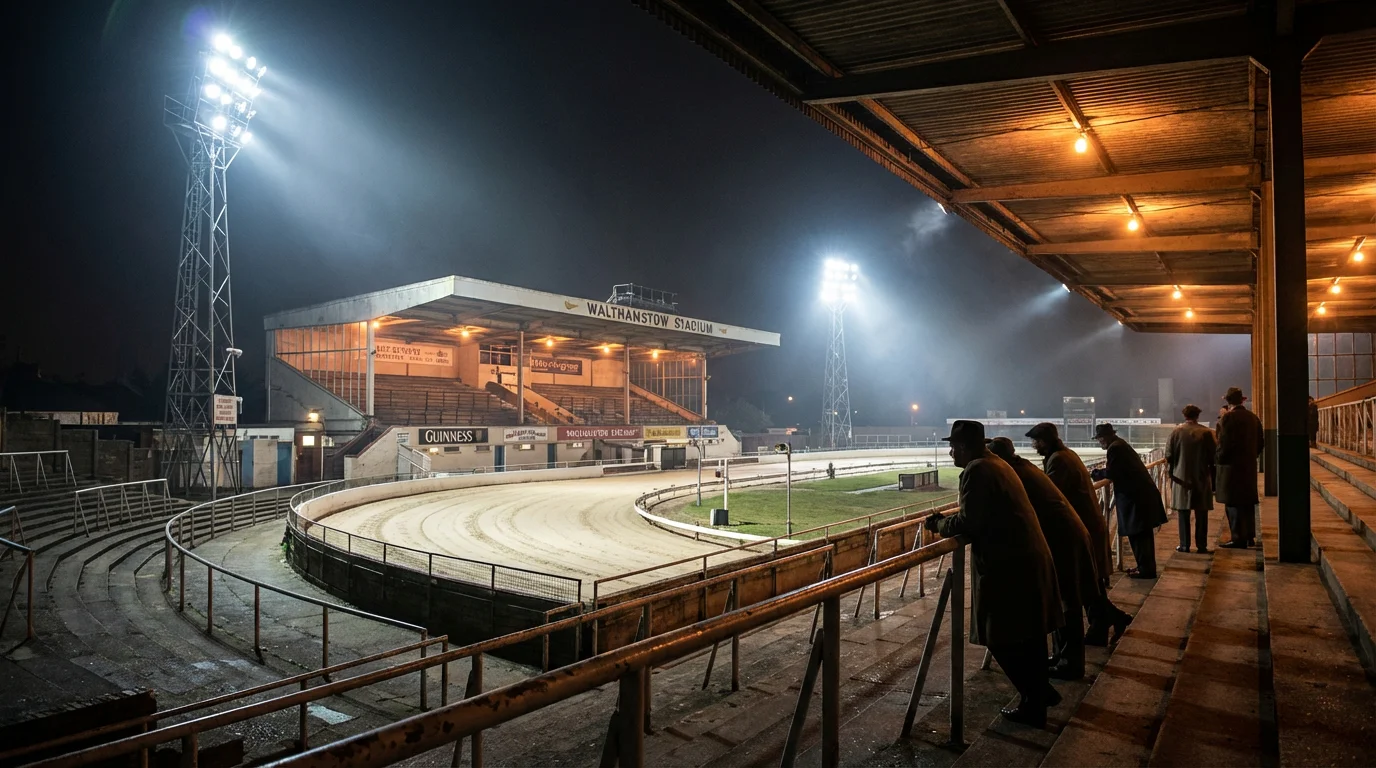
Stadium closures followed the attendance decline. The economics were brutal: greyhound tracks occupied large parcels of urban land whose property value exceeded the revenue the sport could generate. White City closed in 1984. Wembley followed in 1998. Wimbledon — the Derby’s home for over three decades — held its last meeting in 2017, sold to a property developer. Hall Green, Catford, Oxford, Reading — the list of closed tracks reads like a roll call of British cities that once considered greyhound racing part of their identity.
The closures created a vicious cycle. Fewer tracks meant fewer meetings, which meant fewer opportunities for owners and trainers, which reduced the dog population, which further reduced the sport’s visibility and commercial viability. By the 2010s, the number of GBGB-licensed tracks in Britain had fallen below twenty — a fraction of the sixty-plus that operated at the sport’s peak.
Yet the decline was never total collapse. The sport retained a core audience of dedicated punters and enthusiasts, and the remaining tracks continued to operate — some profitably, others through sheer determination. The Derby survived every venue change, every financial crisis, and every round of closures, adapting its host track while maintaining its status as the competition that defined the sport’s calendar.
Modern Regulation and the Current Landscape
The Greyhound Board of Great Britain (GBGB) replaced the NGRC as the sport’s governing body in 2009, inheriting responsibility for regulation, welfare, and the integrity of licensed racing. The GBGB operates under the oversight of the UK Gambling Commission and implements rules covering everything from drug testing and grading to track safety standards and injury reporting. Its role is both administrative and reputational — maintaining the public trust that the sport requires to sustain its relationship with the betting industry.
Welfare has become the defining issue of modern greyhound racing. Public concern about the treatment of racing greyhounds — particularly post-racing rehoming and injury rates — has driven regulatory change and media scrutiny. The GBGB’s welfare standards, the work of the Greyhound Trust and other rehoming organisations, and the 2010 Welfare of Racing Greyhounds Regulations (the first statutory welfare framework for the sport) represent a sustained effort to address these concerns. Whether that effort has been sufficient is debated, but the direction of travel — towards greater transparency and higher welfare standards — is clear.
The commercial model has also evolved. Bookmaker levy payments fund prize money and track infrastructure, while live streaming through SIS Racing has opened greyhound racing to a new generation of online bettors who may never visit a track in person. The betting handle on greyhound racing remains substantial — second only to horse racing among UK racing sports — and the Derby’s profile within the betting market is higher than ever, thanks to the promotional investment that major bookmakers make around the event.
Today, UK greyhound racing operates from a smaller physical footprint than at any point in its history but reaches a wider betting audience through digital channels. The sport’s survival has required constant adaptation — new venues, new commercial relationships, new regulatory frameworks — and the Derby has been the constant through all of it. Whatever the sport looks like in another decade, the Derby will almost certainly still be there.
A Hundred Years of Going to the Dogs
Greyhound racing’s history in Britain is inseparable from the broader history of working-class leisure, urban development, and the betting industry. The sport has been pronounced dead more times than any of its critics can count, and it’s still here — smaller, leaner, and more dependent on the betting pound than ever, but still producing the fastest domesticated athletes on earth and still drawing a crowd on Derby night.
For punters, the history matters because it explains why the Derby carries the weight it does. This isn’t a recently invented competition grafted onto a minor sport. It’s the centrepiece of a century-old tradition, the one race that every trainer, every owner, and every dog in British greyhound racing wants to win. That weight of expectation shapes the competition’s intensity, and that intensity is what makes it worth your attention and your analysis every June.