Best Greyhound Betting Sites – Bet on Greyhounds in 2026
Loading...
The Racecard Tells You Everything — If You Know Where to Look
A greyhound racecard is a compressed biography of every runner in a race. Trap number, recent finishing positions, times, weight, trainer, grade, running comments — it’s all there, packed into a few lines of abbreviated text that experienced punters scan in seconds and newcomers find impenetrable. The gap between those two groups is knowledge, not talent, and closing it is one of the fastest ways to improve your greyhound betting.
This article walks through every element of a standard UK greyhound form guide, from the basic layout to the abbreviations that hide critical information about how a dog actually ran. By the time you finish, you’ll be able to pick up a Derby racecard and extract the same insights that professional form students use to price up a race.
Anatomy of a Greyhound Racecard
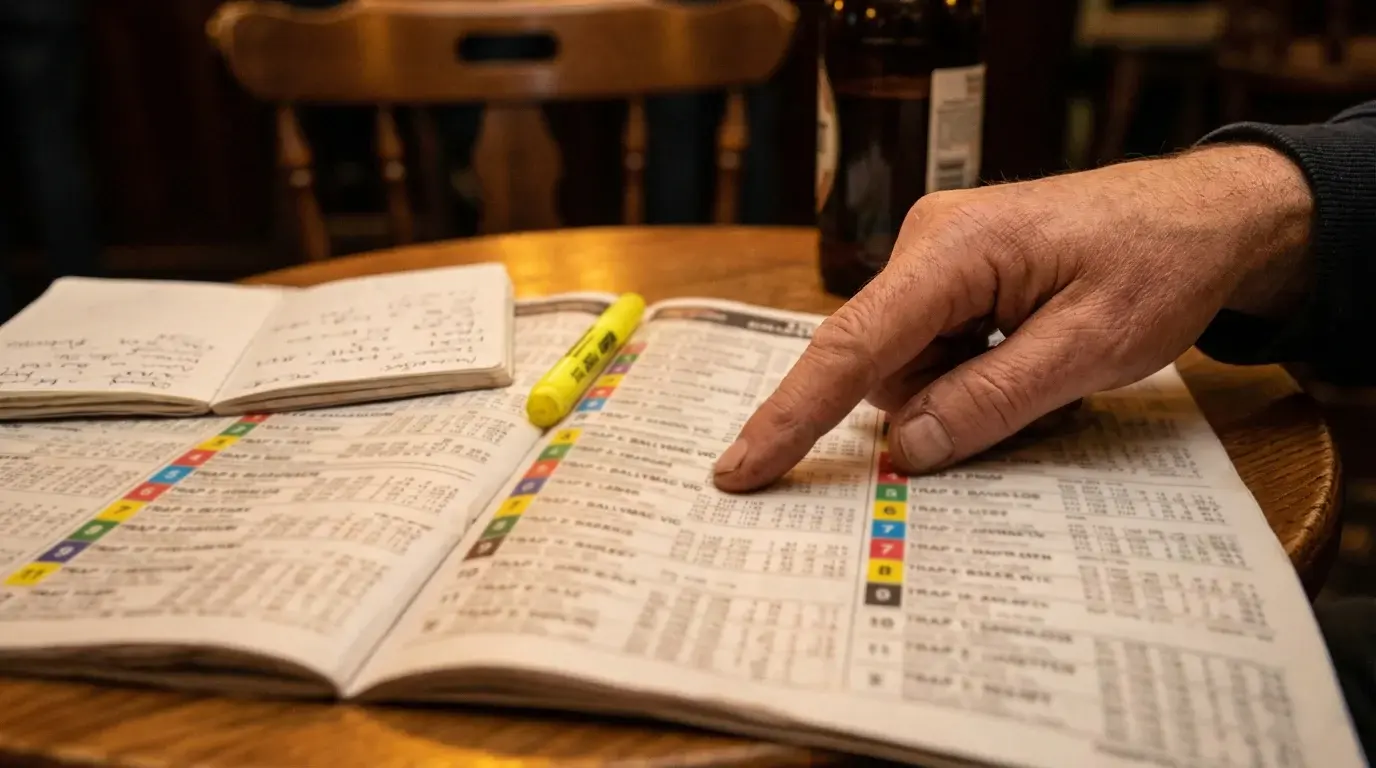
A standard UK greyhound racecard — whether on a bookmaker’s site, in the Racing Post, or on the screen at the track — follows a consistent layout. Each dog occupies one row, and the information flows left to right through several fixed columns. Understanding the structure means you always know where to find what you need, regardless of the source.
The first column is the trap number, from one to six, typically colour-coded: red for trap one, blue for two, white for three, black for four, orange for five, and black-and-white stripes for six. These colours match the jacket the dog wears on the track, making it easy to follow your selection during a race. The trap number also tells you the dog’s starting position — trap one on the inside rail, trap six on the outside.
Next comes the dog’s name, followed by its form figures. These are the finishing positions from its most recent races, displayed as a sequence of digits reading left to right from oldest to most recent. A form line of 2-1-1-3-1 tells you the dog finished second, first, first, third, first across its last five outings. Some cards extend this to six or eight runs; others compress it to the most recent four. A dash or hyphen between figures indicates a break in racing.
The trainer’s name appears alongside or beneath the dog’s name. In Derby betting, trainer identification is more than a formality — certain kennels have a track record of preparing dogs for the specific demands of the competition, and recognising those names gives you an immediate context clue about a runner’s likely preparation.
Weight is listed in kilograms, usually to one decimal place. A standard greyhound racing weight falls between 26 kg and 36 kg, though the range for open-class dogs entering the Derby tends to cluster between 30 kg and 35 kg. Weight changes between races — typically shown by a plus or minus figure — can signal fitness shifts. A dog gaining 0.5 kg between outings might be carrying extra condition; one losing the same amount might be sharpening up or, less positively, under stress.
Finally, the card shows the dog’s recent times and the tracks where those runs took place. A time of 29.45 at Towcester means something different from 28.80 at Nottingham, because track configurations vary. The track abbreviation and distance are essential context for interpreting any time figure. Without them, the numbers are meaningless.
The Numbers That Matter Most
Not all data on a racecard carries equal weight. When assessing a Derby runner, three numbers matter more than anything else: recent times, grade history, and sectional splits.
Recent times are the first thing most punters check, and for good reason — they’re the closest thing to a speed rating the sport offers. But raw times need adjustment. A 29.20 at Towcester on a dry evening is a materially different performance from a 29.20 on a rain-softened track, and both are different from a 29.20 run in a slow-paced heat where the dog led unchallenged from trap one. The time tells you how fast the dog covered the distance; it doesn’t tell you how hard it was working to achieve that. Look at the time in conjunction with the finishing margin — a 29.20 win by six lengths is a much stronger performance than a 29.20 win by a short head, because the first dog likely had more in reserve.
Grade history reveals a dog’s competitive level. UK greyhounds are graded from A1 (the highest standard of graded racing) downwards, with open races sitting above the grading system entirely. Derby entrants are almost exclusively open-class dogs, but their grade trajectory — how quickly they rose through the ranks, whether they’ve been consistently competing at the highest level — tells you about the quality of opposition they’ve faced. A dog that has raced in open company for twelve months is a different proposition from one that was upgraded from A1 six weeks ago, even if their recent times are similar.
Sectional splits break a race into segments — typically first-bend time and run-home time. The first-bend split tells you about a dog’s early pace: how quickly it left the traps and reached the first turn. The run-home time measures finishing speed from the final bend to the line. A dog with a fast first-bend split and a slow run-home is a front-runner that fades. A dog with a moderate split but a quick run-home is a closer that finishes strongest. For Derby betting, where the first bend at Towcester determines much of the race’s shape, the first-bend split is arguably the single most predictive number on the card.
Decoding Comments and Running Lines
Beneath or alongside the numerical data, most racecards include a short text comment describing how the dog ran in its most recent outing. These comments are written by track officials and use a standardised set of abbreviations. Learning the most common ones turns a cryptic string of letters into a vivid picture of the race.
“EP” means early pace — the dog showed speed out of the traps. “Led” or “Ld” confirms it held the lead at some point. “RIs” means raced on the inside, “RW” on the wide outside. “Crd” indicates the dog was crowded — interfered with by other runners, usually at a bend. “Bmp” signals a bump, a physical collision that disrupted its stride. “SAw” means slow away — the dog was slow to leave the traps, costing it early position.
These comments matter because they explain the gap between the time on the card and the dog’s actual ability. A dog that posted 29.55 after being crowded at the first bend and bumped at the third may be capable of 29.20 if it gets a clear run. The time looks ordinary; the comment tells you the performance was compromised. Conversely, a 29.30 recorded as “Led, never challenged” tells you the time may have been soft — the dog wasn’t pressed and likely ran within itself.
Running lines go a step further, describing a dog’s position at key points in the race. A line like “2-1-1-1” means the dog was second at the first bend, led by the second bend, and maintained the lead to the finish. “5-4-3-2” describes a dog that started poorly and closed gradually through the field. For Derby form analysis, the running line is invaluable because it shows you the dog’s racing style in practice rather than theory. A dog described as a railer in its profile but showing running lines of “4-5-4-3” is clearly not operating as advertised — and that disconnect between label and reality is the kind of detail that separates a winning bet from a losing one.
When reviewing Derby racecards, read the comments for at least the last three runs, not just the most recent one. A single bad comment — one slow start, one crowding incident — can happen to any dog. But if the same issue appears across multiple races, it’s a pattern, and patterns are what form analysis is built on.
Form Is a Story — Read the Whole Thing
A greyhound racecard is not a spreadsheet to be scanned for the fastest time and the lowest trap number. It’s a narrative — each dog’s recent races tell a story about its current form, its running preferences, its vulnerabilities, and its potential. The punters who read form most effectively are the ones who resist the temptation to fixate on a single data point and instead build a picture from multiple sources: times, margins, comments, running lines, weight changes, and grade history, all working together.
For the Greyhound Derby, where the field quality is uniformly high and the differences between runners are often marginal, the form guide is your primary analytical weapon. The dog with the fastest single time isn’t always the best dog. The one with the most consistent form across varied conditions, clean running lines, and a running style that suits its likely trap draw — that’s the one the racecard is pointing you towards, if you take the time to read all of it.