Best Greyhound Betting Sites – Bet on Greyhounds in 2026
Loading...
Two Derbies, Two Traditions, One Betting Angle
The English Greyhound Derby and the Irish Greyhound Derby are the two most prestigious races in the sport, separated by the Irish Sea but linked by the dogs and trainers who compete in both. For UK punters, the Irish Derby is not just a separate competition worth following on its own merits — it’s a form source that directly informs English Derby betting, because the same kennels, and often the same dogs, target both events in the same calendar year.
This article compares the two competitions — format, venues, prize money — and, more importantly for bettors, explains how to read Irish Derby form when assessing runners in the English equivalent.
Format and Structure: How the Two Competitions Differ
Both Derbies are knockout competitions, but the structural details diverge. The English Greyhound Derby runs over 500 metres at Towcester on a sand surface, with roughly 192 entries whittled down through first-round heats, second-round heats, quarter-finals, semi-finals, and the final. The entire competition takes place at a single venue over several weeks, meaning every entrant races on the same track throughout.
The Irish Greyhound Derby, held at Shelbourne Park in Dublin, runs over 550 yards (approximately 503 metres) on a grass surface. The entry pool is typically comparable in size, and the knockout structure follows a similar pattern of heats through to a six-dog final. However, the Irish competition has historically been run over a shorter overall timeframe, with rounds scheduled more tightly together.
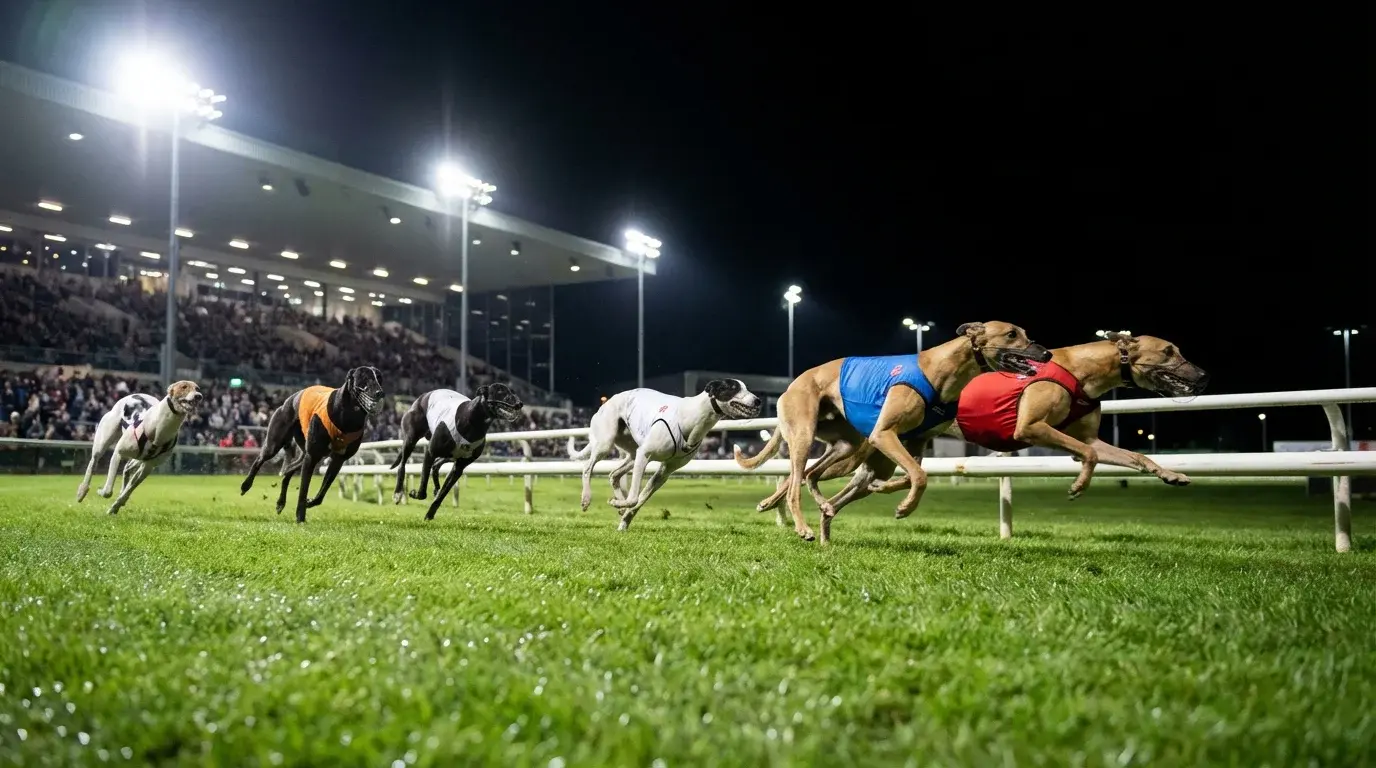
The surface difference is the most significant variable for form comparison. Sand and grass produce fundamentally different racing conditions. Sand is slower, demands more stamina, and favours dogs with physical strength through the bends. Grass is faster, rewards pure speed, and produces tighter margins at the finish. A dog that dominates on the grass at Shelbourne Park may find the heavier going at Towcester a different challenge entirely — and vice versa. Direct time comparisons between the two venues are meaningless; what matters is the quality of opposition beaten and the manner of victory.
The distance difference — 550 yards at Shelbourne versus 500 metres at Towcester — is small in absolute terms (roughly three metres) but can matter at the margins. The Irish distance marginally favours dogs with a stronger finish, as the extra ground gives closers slightly more time to make up ground. At Towcester, where the bends are wider and front runners hold position more reliably, that extra closing opportunity may not translate.
Scheduling is another factor. The Irish Derby typically runs in September, while the English Derby runs in June. Dogs that target both in the same calendar year face the English competition first, then travel to Dublin for the autumn event. This means Irish Derby form from the previous year can be a useful early indicator for the following year’s English Derby — if a dog performed well at Shelbourne in September, it was in peak condition at that point, and the question becomes whether it has maintained or improved that form by June.
Venues, Prize Money, and Prestige
Shelbourne Park is a purpose-built greyhound stadium in Ringsend, inner-city Dublin, with a history stretching back to 1927 — the same year the English Derby began at White City. Its grass track, tight bends, and urban atmosphere create a race-night experience quite different from Towcester’s rural setting. The stadium has undergone multiple refurbishments and remains the flagship venue for Irish greyhound racing under the management of Rásaíocht Con Éireann (Greyhound Racing Ireland).
Prize money has fluctuated in both competitions. The English Derby’s winner’s prize sits at £175,000. The Irish Derby has offered a total purse of €300,000 in recent years, with €125,000 going to the winner, boosted by BoyleSports sponsorship and the strong commercial presence of greyhound racing in Irish betting culture. The prestige of each event is roughly equal within its domestic market, though the English Derby arguably carries more weight internationally due to the UK’s larger betting turnover and media footprint.
For trainers, winning either Derby is a career-defining achievement. Winning both — in the same year or across a career — places a kennel at the very top of the sport. The dual-Derby ambition is what motivates the cross-channel movement of dogs that makes these two competitions so interconnected from a form perspective.
Cross-Channel Raiders: Using Irish Form for English Derby Betting
Irish-trained dogs have become a dominant force in the English Greyhound Derby over the past decade. Trainers like Graham Holland, Patrick Janssens, and Liam Dowling regularly send runners across the Irish Sea, and their dogs have won multiple English Derbies. The era when Irish runners were novelty entries is long gone — they are now expected contenders, and ignoring their form is a guaranteed way to misprice a Derby field.
Reading Irish form for English Derby purposes requires adjustment. The times are not comparable due to the surface and track differences, so you need to focus on performance indicators that are surface-neutral: consistency of finishing positions, quality of opposition, manner of victory (leading throughout versus closing from behind), and the dog’s behaviour under pressure in tight heats where crowding and traffic are factors.
The Irish open-race circuit provides the best cross-reference. Dogs that have won or placed in major Irish Opens — the BoyleSports Irish Derby, the Con and Annie Kirby Memorial, the BoyleSports Irish Oaks — have been tested against top-class opposition and their form carries genuine weight. A dog with two Irish Open wins and a Shelbourne Park time that ranks among the track’s fastest is a serious English Derby contender regardless of how its time translates to Towcester in raw numbers.
Pay attention to how Irish runners perform in their early Towcester trials. Most Irish trainers send their Derby entries to England several weeks before the competition to acclimatise to the sand surface and the track geometry. These trial times, while not competitive races, give you an indication of how well the dog has adapted. A dog that posts a trial time within a few tenths of its Irish race times has likely adjusted well. One that runs significantly slower may be struggling with the surface change, even if its Irish form is outstanding.
The betting market tends to be cautious on Irish raiders early in the competition — the public isn’t always familiar with Irish form, and bookmakers sometimes price Irish entries slightly longer than their ability warrants in the first-round heats. This creates a brief window of ante-post value before the dog’s English heat performances confirm what the Irish form already suggested. Experienced Derby punters exploit this window regularly.
Two Derbies, One Calendar — and Plenty of Overlap
The English and Irish Greyhound Derbies are separate competitions with different surfaces, different venues, and different calendar positions, but they draw from the same talent pool and are shaped by the same trainers. For anyone betting on the English Derby, Irish form is not optional homework — it’s primary source material that tells you about half the serious contenders in the field.
Treat the two competitions as connected data sets rather than isolated events. A dog that ran to the semi-finals of the Irish Derby in September and enters the English Derby the following June has nine months of development between those data points. Track how it has been performing in the interim — in Irish Opens, in trials at Towcester, in any available form — and compare that trajectory against dogs whose form is purely domestic. The punters who integrate both datasets consistently find edges that those who only study English form cannot see.