Best Greyhound Betting Sites – Bet on Greyhounds in 2026
Loading...
The Track Is Not a Constant — and Neither Is the Form
Greyhound form is always produced on a surface, and that surface changes. Rain softens sand and slows times. Heat dries it out and speeds them up. Temperature affects how greyhounds perform physically. Wind can alter the dynamics of the home straight. Yet most punters assess form as if the track is a fixed entity — comparing times from last Tuesday to times from three weeks ago without asking whether the conditions were remotely similar.
This article explains how track conditions affect greyhound racing at Towcester and beyond, what to look for in pre-race reports, and how to adjust your betting when conditions deviate from the norm.
Sand, Grass, and Why the Surface Matters
UK greyhound tracks run on one of two surfaces: sand or grass. Most GBGB-licensed tracks, including Towcester, use sand — a compacted, irrigated surface that provides consistent grip and drainage. A handful of tracks, primarily in Ireland (Shelbourne Park, Curraheen Park) and some UK venues, use grass or a hybrid surface. The two materials produce fundamentally different racing conditions, and form from one surface translates imperfectly to the other.
Sand is slower than grass in absolute terms. The surface absorbs more energy from each stride, demanding greater muscular effort and rewarding dogs with stamina and physical strength. Sand times at Towcester are consistently slower than equivalent distances on grass tracks, not because the dogs are less talented but because the surface resists their movement more. A dog that runs 29.30 at Towcester might clock 28.80 over the same distance on grass — but the performances are equivalent in terms of effort and competitive quality.
For Derby betting, the sand surface at Towcester means that dogs arriving from grass tracks — particularly Irish runners whose domestic form is produced on grass at Shelbourne or Curraheen — face an adjustment period. Some handle the transition seamlessly; others never fully adapt. Trial runs at Towcester before the competition give you an early indication of how well an Irish raider has taken to the sand. A dog that trials within a few tenths of its grass-track times has adapted well. One that is half a second slower may be struggling with the heavier going.
The condition of the sand itself varies. Freshly laid or recently maintained sand is typically looser and slightly slower than a well-compacted surface that has been raced on regularly. Towcester’s ground staff maintain the track to a consistent standard, but natural variation exists — particularly between the first race of the evening, when the surface is freshest, and the later races, when it has been compacted by repeated use. Experienced punters note that times tend to improve marginally as the card progresses, and they adjust their assessments accordingly.
Weather Effects: Rain, Heat, Wind, and What They Change
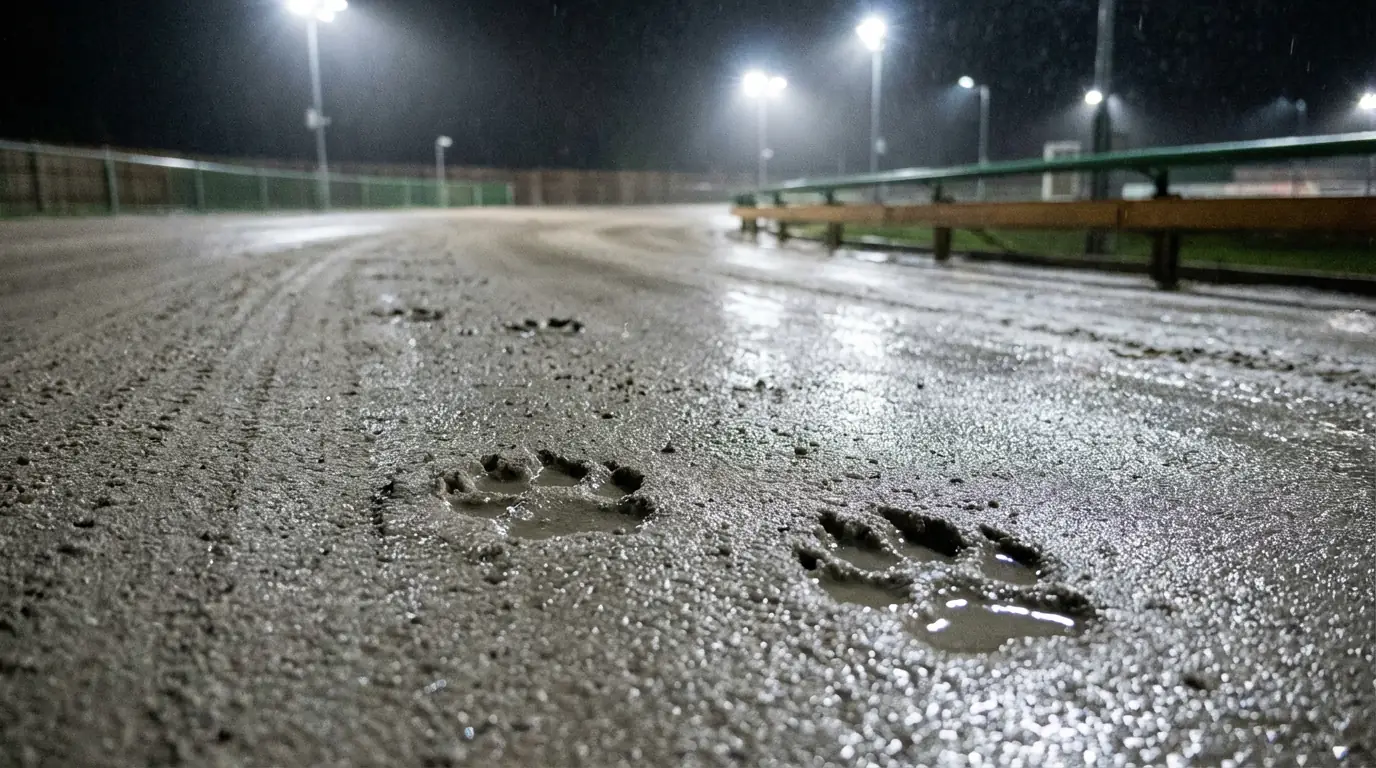
Rain is the most significant weather variable for greyhound racing on sand. Light rain has minimal impact — the irrigated surface is already damp by design. Heavy or prolonged rain, however, saturates the sand beyond its optimal moisture content, making it heavier, softer, and slower. Times on a rain-soaked Towcester track can be three to five tenths slower than on a dry evening, which is enough to render direct time comparisons meaningless unless you account for the difference.
Heavy conditions also change the competitive balance within a race. Dogs with physical power and stamina handle wet sand better than lighter, speed-dependent runners. A front runner that relies on a burst of early pace to establish a lead may find the heavy going blunts its acceleration, allowing stayers and closers to compete on more equal terms. If you’re betting on a night when rain has softened the track, give extra weight to dogs with a history of running well in testing conditions — and be cautious about backing pure sprinters at short prices.
Temperature affects both the track and the dogs. Warm, dry evenings produce the fastest surfaces and the best conditions for peak performance. Cold weather can stiffen muscles and slow early pace, particularly for dogs that haven’t warmed up adequately in the kennels before racing. The effect is modest — perhaps a tenth or two of a second on overall times — but in a Derby final decided by margins of a few hundredths, it’s not negligible.
Wind is a factor that receives less attention but can influence the home straight. A headwind into the finish slows the final 100 metres and benefits front runners who have already established a lead. A tailwind accelerates the finish and helps closers who are gaining momentum through the final straight. At Towcester, the open Northamptonshire landscape means wind exposure is greater than at enclosed urban stadiums, and on blustery evenings the effect is noticeable.
How to Check Conditions Before You Bet
The most reliable source for pre-race track conditions is the GBGB’s official reporting, which includes going descriptions for major meetings. These descriptions — typically ranging from “fast” through “standard” to “slow” — give you a headline assessment of the surface state. For Derby heats and the final, this information is published in the hours before racing and is available through the GBGB website and racing data services.
Bookmaker platforms and racing data sites often include condition information alongside the racecard, though the level of detail varies. Some display a simple “going” description; others include temperature, wind speed, and humidity data. The Racing Post and specialist greyhound sites like GreyhoundStar provide more granular condition reporting that serious form students find indispensable.
The weather forecast for Towcester on race day is your advance planning tool. Check it the morning of the meeting and again an hour before the first race. If rain is expected, prepare your assessments for heavy conditions: adjust your time expectations downward, reassess which dogs handle wet ground, and reconsider any bet based on a time figure produced in dry conditions. If the forecast is clear and warm, the track should race close to its fastest, and recent dry-weather form is directly applicable.
One practical technique is to compare the times from the first race of the evening with recent benchmarks. If the first race produces times that are two or three tenths slower than you’d expect for that grade, the track is riding slow — and you can adjust your expectations for all subsequent races, including the Derby heats or final later on the card. This real-time calibration is more accurate than any pre-race forecast because it reflects the actual surface the dogs are running on, not a prediction of what it might be.
For ante-post betting, conditions are an inherent uncertainty — you’re placing a bet days or weeks before the race, and you cannot know what the weather will do. This is one reason why ante-post betting carries higher reward: you’re accepting the risk of conditions working against your selection, and the price reflects that risk. If your selection is a dog that handles all conditions equally well, the ante-post risk is reduced. If it’s a specialist that thrives only on fast ground, a rainy Derby night could undermine its chance regardless of how strong the form looked in dry-weather heats.
Conditions Are Data — Treat Them That Way
Track conditions are not an excuse for a losing bet — they’re information that should have been incorporated before the bet was placed. The punters who consistently profit from greyhound racing are the ones who treat conditions as a variable to be measured and accounted for, not a surprise to be complained about after the result. A time figure without a going description is half a data point. A form assessment that ignores the weather is half an analysis.
Before every Derby bet, ask two questions: what were the conditions when this form was produced, and what will the conditions be when the dog races next? If the answers are different, your assessment needs adjusting. If they’re the same, your comparison is clean. That simple discipline — conditions in, conditions out — adds a layer of accuracy to your betting that most of your competition doesn’t bother with.