
The Derby Is the Peak — But the Calendar Has Depth
The English Greyhound Derby dominates the sport’s calendar, but it doesn’t exist in isolation. A full season of major open races runs throughout the year, each with its own history, its own form significance, and its own betting opportunities. For punters who treat greyhound racing as a year-round pursuit rather than a single-night event, understanding the broader calendar provides context for Derby form and a steady supply of high-quality racing to bet on between June and the following June. Stay updated at greyhoundderbyfinal.
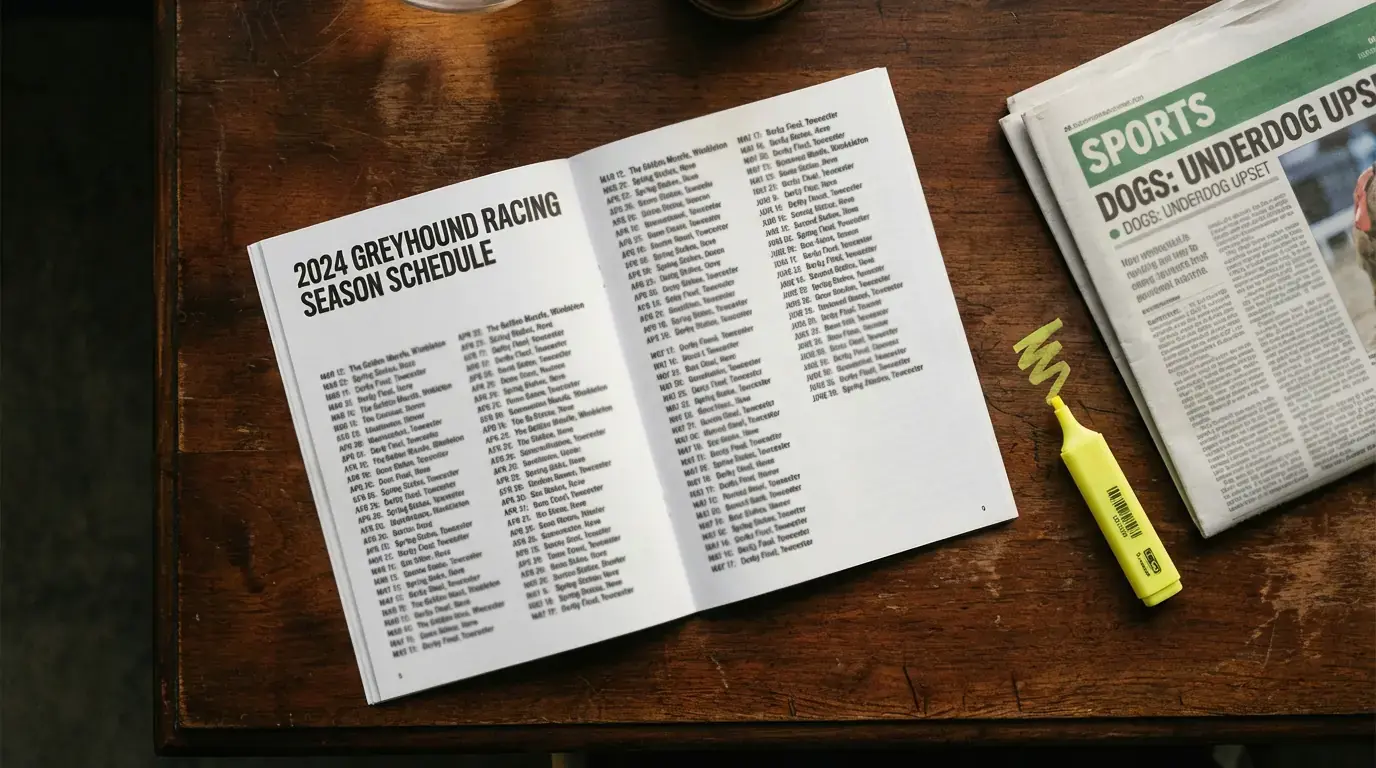
This article maps out the major races in the UK greyhound calendar — their venues, distances, approximate timing, and how they connect to the Derby season.
The Derby and the St Leger: The Two Classics
The English Greyhound Derby, held at Towcester over 500 metres in June, needs no further introduction on this site. It is the sport’s most prestigious competition, carrying the largest prize fund and attracting the strongest field of any UK greyhound race. The knockout format runs across several weeks, with first-round heats typically beginning in late May and the final falling in late June or early July.
The Greyhound St Leger is the sport’s second Classic, traditionally held at Wimbledon and now running at various venues following the closure of the Plough Lane track. The St Leger is contested over a longer distance — typically 710 metres — which gives it a different competitive profile from the Derby. Speed alone is not enough at this trip; the St Leger rewards dogs with genuine stamina and the ability to sustain pace over two additional bends compared to the standard 500-metre race.
The St Leger’s position in the calendar — usually autumn — means it often features dogs that competed in the Derby earlier in the year. A Derby semi-finalist that lacked the raw pace for the 500-metre final may find the longer St Leger distance more to its liking, and the form overlap between the two competitions creates valuable cross-reference for punters who follow both.
Together, the Derby and the St Leger form the core of the greyhound Classics — the two races that every open-class dog and every leading trainer want to win. A dog that captures both in the same year, or across a career, enters the sport’s pantheon alongside its most celebrated names.
The Oaks, the Grand National, and Other Marquee Events
The Greyhound Oaks is the premier bitches-only competition, restricted to female greyhounds and typically run over 480 to 500 metres. The Oaks carries significant prestige and prize money, and its competitive quality is often underrated by punters who focus exclusively on the open-sex events. Bitches that win the Oaks are frequently among the best dogs of their generation regardless of sex, and their form carries into subsequent open competitions.
The Grand National — greyhound racing’s version, not the horse racing event at Aintree — is a hurdle race, contested over a longer distance with flights of hurdles that dogs must clear. It tests a different set of athletic abilities: jumping technique, the courage to attack obstacles at speed, and the stamina to maintain pace over a distance that exceeds the standard flat race. The Grand National occupies a unique position in the calendar as the one major event where flat-track form is an incomplete guide — you need to know whether a dog can jump before you can assess its chance.
The Scottish Greyhound Derby and the Welsh Greyhound Derby are national variants that carry regional prestige and attract competitive fields. Neither matches the English Derby in prize money or field quality, but both serve as useful form trials for dogs that subsequently enter the English competition. A Scottish or Welsh Derby winner that enters the English Derby brings proven knockout-competition form, which is a relevant indicator even if the standard of opposition was a tier below the English final.
The Eclipse, the Gold Collar, and various invitational open stakes at tracks like Nottingham, Romford, and Hove fill out the mid-tier of the calendar. These events don’t carry the profile of the Derby or St Leger, but they produce high-quality racing and meaningful form lines. A dog that wins the Gold Collar at Romford in March and enters the Derby in June has established its credentials at the top level, and the form reference is useful for early-round Derby assessment.
The Supporting Calendar: Year-Round Open Racing
Beyond the named competitions, the UK greyhound calendar includes a year-round programme of open races at GBGB-licensed tracks. These are not knockout competitions but standalone open events — typically single-night affairs with heats and a final, or invitation-only races for the top-rated dogs at a given venue. They run throughout the year and provide the competitive environment in which Derby contenders sharpen their form between major events.
The frequency of open racing means that a dog entering the Derby has typically raced in several open-class events in the preceding months, giving punters a rich body of form to work with. Dogs that have been winning or placing in opens at Towcester itself provide the most directly relevant form, because they’ve demonstrated their ability on the same surface and at the same track geometry they’ll encounter in the Derby.
Irish equivalents — the Irish Greyhound Derby at Shelbourne Park, the Con and Annie Kirby Memorial at Limerick, and the various Irish open stakes — form a parallel calendar that feeds into the English competition through cross-channel entries. The Irish season runs slightly offset from the English calendar, with the Irish Derby typically held in September, which means Irish form from the previous autumn and winter provides a baseline for assessing Irish runners entering the English Derby the following June.
For serious year-round punters, the calendar never stops. There is always an open race to study, a form line to update, and a dog to track through its development from maiden winner to Derby contender. The punters who arrive at Derby week with twelve months of accumulated knowledge have an edge that no amount of last-minute cramming can replicate.
The Derby Sits at the Top — Everything Else Leads to It
The UK greyhound racing calendar is structured, whether intentionally or not, as a series of stepping stones towards the Derby. The winter opens identify the emerging talent. The spring stakes sharpen the form. The Scottish, Welsh, and Irish national competitions test dogs in knockout formats. And by the time the first Derby heat runs in late May, every serious contender has a body of form that stretches back months and tells a story that the racecard compresses into a few lines of figures and abbreviations. Also read our how to watch the greyhound Derby.
Understanding the full calendar gives you context that single-race bettors miss. When you see a Derby entrant with a Gold Collar win and two open placings at Towcester in the spring, you know where that dog has been and what it’s proven. When you see one with no major open form and a sharp rise through the grades, you know the potential is there but the evidence at the highest level is thin. The calendar is the backdrop against which every Derby story is written — and the more of it you’ve followed, the better you’ll read the final chapter.
