Best Greyhound Betting Sites – Bet on Greyhounds in 2026
Loading...
The Track and the Format Are Two Halves of the Same Bet
You can’t bet the Derby intelligently without understanding both the competition format and the track it runs on. These two elements — the knockout structure that filters 192 entries down to six finalists, and the specific Towcester circuit where the entire competition unfolds — are not background information. They are the framework within which every piece of form data, every trap draw, and every price makes sense. Ignore either one and you are placing bets on a race you haven’t fully understood.
The format matters because it dictates the type of dog that survives to the final. The Derby doesn’t reward the fastest single performance in the draw — it rewards the dog that can reproduce quality across four, five, or six races over consecutive weeks. That is a different kind of excellence, and it shapes how the market should be read at every stage of the competition.
The track matters because Towcester is not a generic greyhound circuit. Its 500-metre sand oval has specific characteristics — bend profiles, surface depth, trap biases — that favour certain running styles and penalise others. A dog that excels at Romford or Monmore might struggle at Towcester, and vice versa. The track is not a neutral venue. It is a variable, and treating it as anything else is a mistake.
This guide covers both halves in full: the competition format from first heat to final night, and the Towcester track from surface to sectional times. Together, they give you the context you need to evaluate every dog, every race, and every price that the Derby produces.
English Greyhound Derby Format in Full
192 entries. Six rounds. One final. Here’s how the numbers thin. The English Greyhound Derby is a knockout competition run over approximately six weeks, typically from mid-May through late June. It is open to greyhounds registered with the Greyhound Board of Great Britain and accepts entries from trainers across Britain, Ireland, and occasionally continental Europe. The entry process begins months before the first heat, with trainers nominating their best dogs and paying an entry fee that escalates at each stage.
The competition structure follows a classic pyramid format. The initial entry of 192 dogs is divided into first-round heats, with six dogs per heat. From each heat, three dogs qualify for the next round based on finishing position — the first three home progress, the rest are eliminated. This three-from-six qualifying rate means that the field is halved after every round, creating a rapid narrowing that pressurises every race from the first heat onward.
The reserve system provides a safety net for the competition’s integrity. After each round, the fastest losers — dogs that finished fourth but ran times competitive with the qualifiers — may be seeded into the next round as reserves if a qualified dog is withdrawn through injury or other reasons. This system ensures that the best available dogs continue to progress even if attrition removes a qualifier, and it occasionally produces stories of late replacements running deep into the competition.
The overall timeline unfolds roughly as follows: first-round heats occupy one to two nights of racing, with up to 32 heats run across the card. The second round, quarter-finals, semi-finals, and final each occupy subsequent weeks, with the final scheduled as the centrepiece of a dedicated race night. By the time the final six are confirmed after the semi-finals, the surviving dogs have each won three or four races at the same track, under escalating competitive pressure, within a four-week window. The format is a stress test, not a sprint.
For the betting market, the format’s significance is structural. Each round generates new data — times, running lines, trap performances, responses to pressure — that updates the market’s assessment of every surviving dog. The ante-post market contracts after each round, with prices sharpening as the information base grows. A punter who follows the competition round by round has a compounding information advantage over one who only looks at the final.
Heats, Quarter-Finals and Semi-Finals
Three qualify from each heat — and the margin between qualification and elimination is often a nose. The early rounds of the Derby are where the bulk of the attrition happens, and the racing is frequently closer than the pre-race market suggests. Dogs that are 4/6 favourites in the first round can find themselves in a battle for third, because the six-dog heat format compresses the quality band. Unlike graded racing, where the field is tiered by ability, Derby heats deliberately mix dogs from different levels, creating races where an underestimated outsider can shock the favourite.
The trap draw for each round is conducted by the GBGB and takes place in the days before race night. The draw is not random in the sense of a blind ballot — the GBGB considers running styles and attempts to avoid clustering all railers on the inside or all wide runners on the outside. In practice, the draw still produces mismatches, and dogs occasionally draw a trap that conflicts with their natural running line. This is a betting opportunity. A strong dog drawn in an awkward trap will often drift in the market, creating a price that overestimates the difficulty and underestimates the dog’s ability to adapt.
Quarter-finals and semi-finals are where the competition intensifies. By the quarter-final stage, the weakest dogs have been eliminated and every heat features six runners with legitimate credentials. The qualifying rate remains three from six, but the quality gap between third and fourth narrows to almost nothing. Semi-final nights produce some of the Derby’s most dramatic racing, because every dog remaining is one race from the final and the incentive to peak is at its highest.
From a betting perspective, the semi-finals are the most informative round. The six dogs in each semi have all demonstrated the ability to win at Derby level, and the race provides a final data point — time, running style, response to competitive pressure — before the final itself. A dog that wins its semi comfortably, running a fast time from a favourable position, enters the final with verified credentials. A dog that scrapes through in third, finishing on fumes, enters the final with a question mark over its ability to sustain the effort for one more round.
The Final: Structure, Timing and Prize
The final occupies a single race on a 15-race card — but it’s the only one anyone remembers. The Derby final is scheduled as the feature race of a dedicated evening programme at Towcester, typically the last Saturday in June. The undercard consists of graded and open races, building the atmosphere through the evening before the main event, which is usually timed for around 9:15pm.
The six finalists are confirmed after the semi-finals, and the final trap draw takes place in the intervening days. The draw is the last major piece of information before the race, and it triggers the final wave of odds movement as the market reassesses each dog’s chance based on its trap position relative to its preferred running style. A dog that has led from trap one throughout the competition and draws trap six in the final faces a different tactical challenge, and the market prices that adjustment accordingly.
The first prize currently stands at £175,000, making the English Greyhound Derby the richest race in British greyhound racing by a significant margin. Prize money is distributed through the places, with second through sixth receiving progressively smaller amounts. For trainers, the financial incentive is matched by the reputational reward — a Derby victory elevates a kennel’s profile and the breeding value of the winning dog in a way that no other race can replicate.
For the punter, the final is the culmination of everything the competition has produced. Six dogs, six traps, 500 metres, and approximately 28 seconds of racing. The market on final night is the tightest and most efficient of the entire competition. The information is complete, the prices are sharp, and the margin for error — both for the dogs and for the punters — is minimal.
Towcester Greyhound Stadium: The Full Track Guide
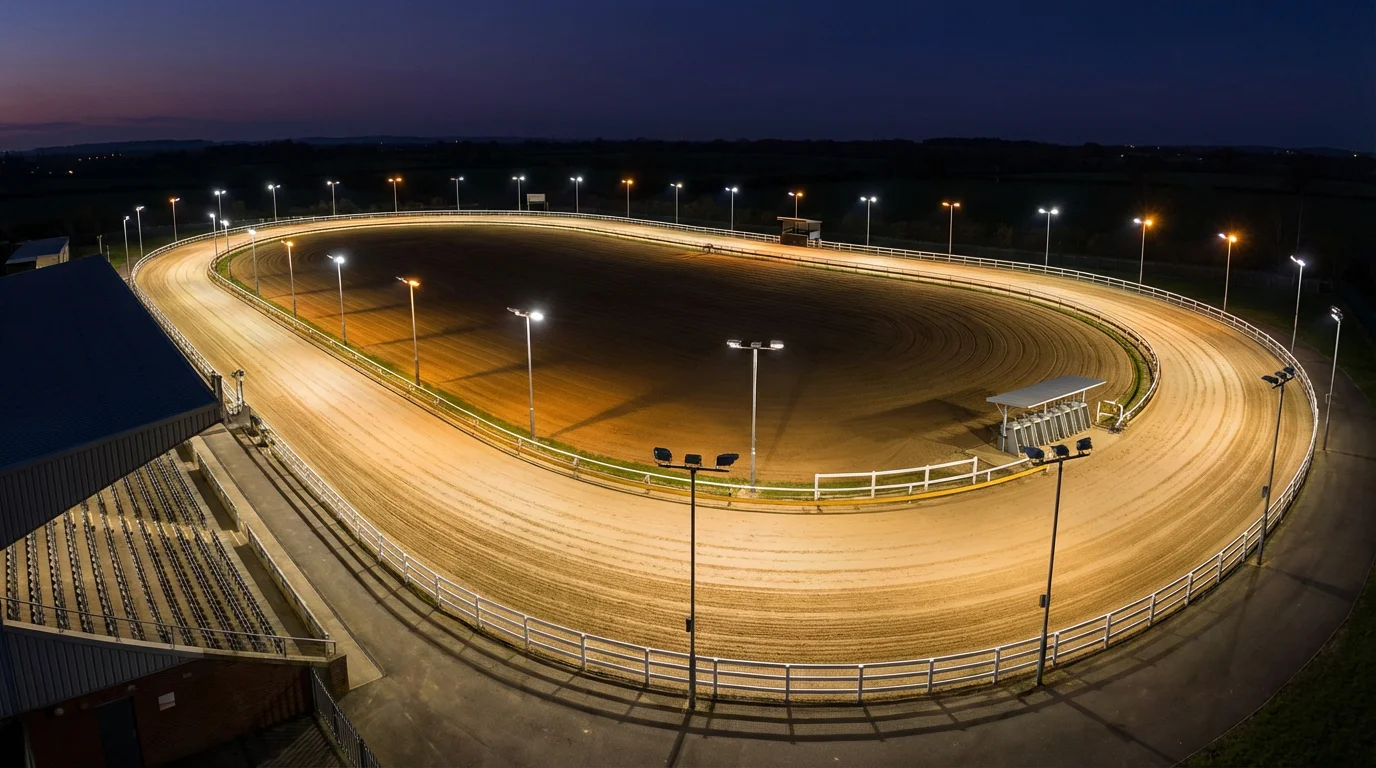
Towcester’s 500-metre sand oval has hosted the Derby since 2017 — here’s what makes it distinctive. The stadium sits on the outskirts of Towcester, a small market town in south Northamptonshire, roughly equidistant from Milton Keynes and Northampton. The location is a world away from the urban stadiums that previously hosted the Derby — White City in west London, Wimbledon in south London — and the rural setting creates a different atmosphere. The track itself, however, is a serious racing venue with characteristics that reward specific types of greyhound.
Towcester is an oval track with four bends, configured for races over 480 metres and 500 metres. The Derby is run over the longer distance, which includes a slightly extended run to the first bend. This extended run matters: it gives dogs more time to find their position out of the traps, which reduces — but does not eliminate — the advantage of early pace. At tracks with a shorter run to the first bend, the dog that breaks fastest almost always leads into the turn. At Towcester, a dog can recover from a moderate start if it has the sustained speed to make ground through the middle section of the race.
The surface is deep sand, which is heavier underfoot than the shallower sand used at some other tracks. The depth absorbs impact — reducing injury risk over the course of a multi-week campaign — but it also saps speed. Towcester times are generally slower than equivalent distances at tracks like Nottingham or Monmore, and direct time comparisons across tracks are misleading without adjustment. A 28.80 at Towcester and a 28.80 at Nottingham are not the same performance, and treating them as interchangeable is an error that distorts form assessment.
The track underwent a period of closure and administrative upheaval in 2018-2019, during which the Derby temporarily relocated to Nottingham. Towcester was subsequently rescued, refurbished, and returned to operation, and the Derby came back with it. The refurbishment improved drainage and surface consistency, which has made recent times more reliable as a form guide than the pre-closure data. Punters should treat Towcester form from 2021 onward as the most relevant baseline for current Derby assessment.
Track Surface, Dimensions and Bend Profiles
Sand absorbs shock but drags speed — and Towcester’s bends reward dogs who can hold a tight line. The four bends at Towcester are relatively wide-radius compared to tighter circuits like Wimbledon or Romford, which means that the centrifugal forces pulling dogs wide are lower. Dogs that tend to drift wide on tighter bends often run truer lines at Towcester, and this can produce improved performances from dogs whose previous form at other venues was compromised by bend trouble.
The first and second bends — the turns that the dogs hit at maximum speed coming off the straight — are the most critical for betting purposes. A dog that negotiates the first bend cleanly, without checking or being forced wide by a rival, typically maintains its position through the remainder of the race. Crowding at the first bend is the single most common cause of underperformance in Derby heats, and it is disproportionately likely to affect dogs drawn in the middle traps — three and four — where traffic from both sides can create interference.
The back straight at Towcester is where dogs with sustained pace make their ground. Unlike tracks with a short back straight, where the gap between bends leaves little time for overtaking, Towcester’s longer straight rewards dogs that can accelerate coming off the second bend and carry speed into the third. This is a measurable characteristic — dogs with strong run-home sectional times at Towcester tend to perform better across multiple Derby rounds than dogs whose speed is concentrated in the first 200 metres.
The finishing straight is slightly uphill, which adds a stamina element to the final 100 metres. In close finishes, the dog with greater reserves tends to prevail on the Towcester rise. This is a subtle but consistent factor that favours dogs bred for endurance over pure sprinters, and it is another reason why Derby form at Towcester does not translate directly from times recorded on flat tracks elsewhere.
Track Records and Sectional Benchmarks
The 500-metre track record at Towcester provides a ceiling against which all Derby performances can be measured. Sectional times — particularly the split from trap to first bend and the run-home time from the final bend to the line — offer a more granular view of performance than overall race time alone.
The first-bend split tells you how quickly a dog reached its racing position. A fast split from trap one suggests a clean break and an unobstructed run to the inside rail. A fast split from trap six is more impressive, because the dog has had to cross the track to find daylight. Comparing first-bend splits across rounds reveals whether a dog is consistently fast out of the traps or whether a single quick break was an outlier.
The run-home time — the final section from the last bend to the finishing line — indicates how well a dog sustains its speed over the course of the race. A dog with a strong run-home time is finishing its races with energy in reserve, which is a positive indicator for survival in later rounds. A dog with a weak run-home time, even if its overall time is competitive, may be running at the limit of its stamina and could regress as the competition demands another effort the following week.
Benchmarks shift with conditions. Sand depth, moisture, temperature, and wind all affect track speed on any given night. A time of 28.60 on a fast night is not equivalent to 28.60 on a slow one. The most reliable form comparison is against the times of other dogs on the same card, the same night, rather than against historical records. If the fastest time on the card is 28.50, a dog running 28.70 is within two lengths of the best — a narrow margin in a competitive Derby heat.
Derby Final Night: What to Expect
Derby night at Towcester is a full programme — undercard, support races, and the final as the evening’s centrepiece. The card typically features fifteen races, beginning in the early evening and building through to the main event. The undercard includes a mix of graded races and open events, some of which feature dogs eliminated from the Derby in earlier rounds, providing a secondary betting interest for punters who have been following the competition.
The atmosphere on final night is markedly different from a standard evening’s racing. Attendance is higher than any other night in the greyhound calendar, and the crowd includes a significant number of once-a-year visitors drawn by the event’s profile. This matters for the betting market because the influx of casual money can distort the odds. Dogs with name recognition or media coverage attract disproportionate public money, shortening their price and creating potential value on the less fancied runners in the field.
The parade of finalists before the race is a moment of theatre that serves a practical purpose for the attentive punter watching at the track or on screen. Observing the dogs in the parade ring — their demeanour, their coat condition, their handler’s body language — provides a final piece of subjective information before the race. A dog that appears anxious or unsettled in the parade ring may not replicate its best form under the heightened atmosphere. A dog that appears calm and focused is more likely to break cleanly and run to its ability. This is not science, but experienced trackside observers treat the parade as a legitimate input to their assessment.
The final itself is run and settled in under thirty seconds. The starting prices are declared, the traps open, and six dogs chase the mechanical hare around the 500-metre circuit. For all the weeks of preparation, analysis, and market study, the outcome is determined by a burst of racing that allows no human intervention and very little tactical adjustment. The result is immediate, and the market settles within minutes. Derby night compresses months of anticipation into a single, irreversible moment — and that compression is both the event’s appeal and its essential challenge for anyone betting on it.
How to Watch: TV, Stream and On-Track
The Derby final is available through multiple channels, and choosing the right one depends on whether you want the full production or just the race footage. For punters who need to see the race in real time, the options break down into three categories: on-track attendance, broadcast coverage, and bookmaker streaming.
On-track attendance at Towcester gives you the complete experience — the atmosphere, the noise of the crowd, and the unmediated view of the race from trackside. Tickets for Derby final night are available through the Towcester stadium website and typically sell well in advance. If you plan to attend, book early and be prepared for a full evening programme. The practical benefit of attending is immersion: you absorb details about the dogs, the track conditions, and the market mood that no screen fully captures.
Broadcast coverage of the Derby is carried by SIS Racing (Satellite Information Services), which supplies live greyhound racing feeds to betting shops and online platforms across the UK. SIS commentary covers every Derby race from the first-round heats through to the final. For the final itself, the coverage is enhanced with pre-race analysis, interviews, and post-race reaction. The SIS feed is the standard source used by most bookmakers for their in-app and on-site live streams.
Bookmaker live streaming is the most accessible option for punters watching from home. Major operators including bet365, Coral, Betfred, and William Hill stream live greyhound racing to customers who have a funded account or have placed a bet on the relevant meeting. The quality of the stream varies between operators, but for the Derby final, all major bookmakers carry the SIS feed. Some offer additional camera angles and enhanced graphics on final night, reflecting the event’s commercial importance.
For punters who cannot watch live, race replays are typically available within minutes of the result through the bookmaker’s platform and on dedicated greyhound racing websites. Replays are valuable for post-race analysis — reviewing how the race unfolded, which dogs were checked at the bends, and how the pace developed through the race. This information feeds directly into form assessment for future betting, even if the Derby itself is a once-a-year event.
Know the Arena Before You Back a Dog
Track knowledge isn’t trivia — it’s a betting edge. Every assessment you make of a Derby runner is filtered through two questions: can this dog handle the format, and can it handle the track? A brilliant dog that cannot sustain its form across multiple rounds will be eliminated before the final. A fast dog whose running style is unsuited to Towcester’s bend profiles and deep sand will underperform its raw ability. The format and the track are the filters through which talent must pass, and understanding those filters is the prerequisite for evaluating anything else.
The format rewards consistency. Look for dogs that replicate their performance across rounds rather than producing a single standout time. Watch how each dog responds to the qualifying pressure — does it rise to the challenge or does it fade when the field tightens? The best Derby bets tend to be the dogs that win their heats comfortably enough to suggest they have more in reserve, without running so fast that they have nothing left for the semi-final.
The track rewards adaptability. A dog that has trialled well at Towcester, negotiated the bends cleanly, and recorded competitive sectional times on the surface is a safer proposition than one arriving with faster times from a different track configuration. Track-specific form is the single most undervalued data point in the Derby ante-post market, because the public tends to focus on headline times without adjusting for the venue where those times were recorded.
Know the format. Know the track. Then study the dogs. That sequence — arena first, runners second — is the approach that the Derby’s structure demands, and it is the approach that gives you the clearest possible view of where the value sits when the market opens.