Best Greyhound Betting Sites – Bet on Greyhounds in 2026
Loading...
Odds Are a Language — Here’s How to Speak It
If you can’t read odds fluently, you’re betting blind. That sounds harsh, but it is the single most consequential gap in any punter’s knowledge. You can study form for hours, identify the right dog in the right race, and still lose money over time if you consistently take prices that don’t reflect the actual probability of the outcome. Odds are not a decoration bolted onto the racecard — they are the mechanism through which every penny of profit or loss is determined.
The Greyhound Derby is a particularly instructive arena for understanding odds, because the six-runner field creates a cleaner mathematical environment than horse racing’s larger fields. With only six dogs in every race, the implied probabilities are more transparent, the bookmaker’s margin is easier to spot, and the differences between operators are more visible. If you are going to learn how odds work and how to exploit them, a six-dog race is the right classroom.
This guide covers the full lifecycle of a Greyhound Derby price: how odds are created, what format they come in, why they move, how to compare them between bookmakers, and — most importantly — how to determine whether a price represents genuine value or just a big number. Understanding odds is not a preliminary step that you complete and then forget. It is the continuous, active skill that separates recreational punters from those who make the market work in their favour.
Every bet you place on the Derby is a transaction at a specific price. The quality of that transaction depends entirely on whether you understand what you are buying.
How Greyhound Racing Odds Are Set
Bookmaker odds start with probability — and finish with margin. The process of setting odds on a Greyhound Derby race begins, in principle, with an assessment of each dog’s chance of winning. A six-runner race with equally matched dogs would price each runner at 5/1 in fractional terms, or 6.0 in decimal — a 16.67% implied chance for each, totalling exactly 100%. In practice, no six-dog race features equally matched runners, and no bookmaker prices to exactly 100%.
The initial prices for a Derby race are set by a bookmaker’s compiling team, which combines form analysis, track data, kennel reports, and market intelligence to produce an opening show. This opening show is the first visible indication of how the bookmaker assesses the race. It is also the most volatile — prices at this stage are based on the compiler’s judgement, and they will adjust rapidly once money starts flowing from the betting public.
Once the market opens, the odds become a live conversation between the bookmaker and the punters. If heavy money comes for one dog, its odds shorten and the odds on the other five lengthen. If the money is evenly spread, the prices remain relatively stable. The bookmaker’s objective is not to predict the winner — it is to balance the book, ensuring that the total liability across all outcomes is manageable. The margin built into the prices provides the bookmaker’s profit regardless of which dog wins, provided the book is reasonably balanced.
For the Derby specifically, the compiling process begins weeks before the first heat with the ante-post market, and it sharpens through each round as the field narrows and more race-specific data becomes available. The opening ante-post odds are necessarily loose — the compiler is pricing 192 entries based on pre-competition form and reputation. By the time the final six are known, the prices are tight, data-rich, and far more accurate as a collective reflection of each dog’s chance.
Understanding this process matters because it tells you where the inefficiencies are most likely to live. Early in the competition, when the information is thin and the margin is wide, the odds are least reliable as indicators of true probability. Late in the competition, when the market has been refined by multiple rounds of actual racing, the prices are sharper and harder to beat. The implication is clear: if you want to find prices that are wrong, look early. If you want prices that are accurate, look late. The strategy depends on which end of that spectrum you want to operate on.
Fractional, Decimal and American Formats
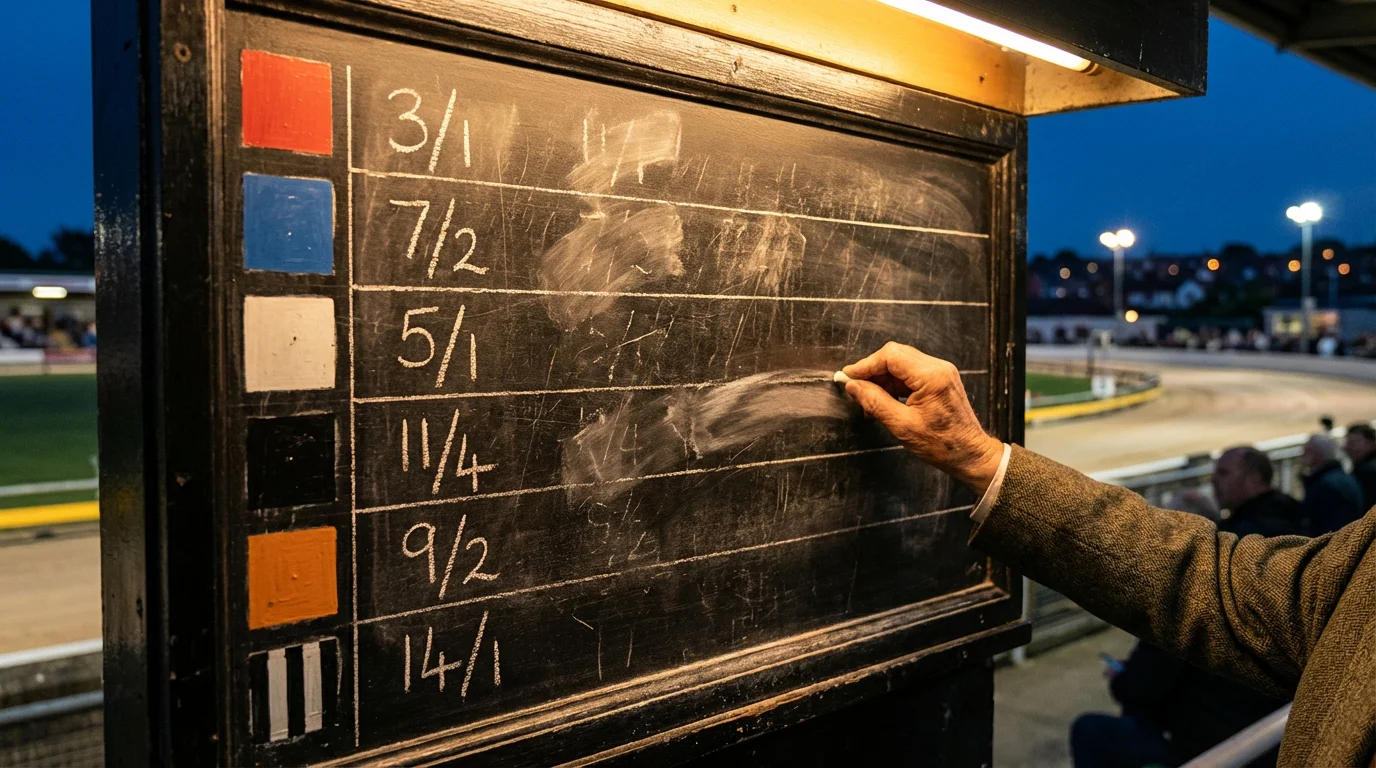
3/1 means three to one. 4.0 means the same thing. Here’s how to switch fluently. In the UK, greyhound odds are overwhelmingly displayed in fractional format — 3/1, 7/2, 11/4, and so on. The first number represents the profit, the second represents the stake. At 3/1, a £10 bet returns £30 profit plus your £10 stake, totalling £40. At 7/2, a £10 bet returns £35 profit plus £10 stake, totalling £45.
Decimal odds, standard across continental Europe and increasingly common on UK betting sites, express the total return per unit staked. A decimal price of 4.0 is identical to 3/1 — a £10 bet at 4.0 returns £40 total. The conversion is straightforward: add one to the fractional odds expressed as a decimal. 3/1 becomes 3.0 + 1 = 4.0. 7/2 becomes 3.5 + 1 = 4.5. Most UK bookmakers allow you to toggle between fractional and decimal display in your account settings, and there is no practical advantage to either format beyond personal familiarity.
American odds, which you will encounter if you stray onto US-facing sportsbooks, use a plus-or-minus system around a baseline of 100. A +300 price is equivalent to 3/1. A -200 price means you must stake £200 to win £100, which translates to 1/2 in fractional terms. American odds are rare in UK greyhound betting, but they occasionally appear on international comparison tools, so understanding the conversion prevents confusion.
The format is cosmetic. What matters is the implied probability that the odds represent. To convert any odds into an implied probability: divide 1 by the decimal odds. At 4.0, the implied probability is 1/4.0 = 25%. At 2.5, it is 1/2.5 = 40%. This conversion is the single most useful calculation in betting, because it allows you to compare the bookmaker’s assessment of a dog’s chance directly with your own.
Understanding the Bookmaker’s Margin
A six-dog race should price at 100% — every point above that is the house edge. In theory, the sum of implied probabilities across all six runners should equal exactly 100%, reflecting the mathematical certainty that one of them will win. In practice, the total always exceeds 100%, and the excess is the bookmaker’s overround — the built-in margin that ensures profit regardless of the result.
A typical greyhound race at a BAGS meeting might price at 118-125%, meaning the bookmaker holds an 18-25% theoretical edge. Derby races tend to be tighter, in the range of 112-118%, because the higher profile of the competition attracts more money, more competition between bookmakers, and sharper pricing. The lower the overround, the less you are paying in invisible commission on every bet.
Calculating the overround is simple. Convert each runner’s fractional odds to implied probability and sum the results. If the six dogs are priced at 2/1, 3/1, 5/1, 6/1, 8/1, and 10/1, their implied probabilities are 33.3%, 25.0%, 16.7%, 14.3%, 11.1%, and 9.1%, totalling 109.5%. The overround is 9.5%. In a Derby heat, where the competitive balance is often closer than in a graded race, you may find the overround pushed higher because the bookmaker compensates for tighter margins between runners by widening the overall margin on the race.
Why does this matter? Because the overround is the cost of playing. Every percentage point of overround is a percentage point that comes out of the collective punters’ pocket. Seeking bookmakers with lower overrounds on Derby races is the most mechanical and reliable form of edge available — it requires no form knowledge, no insider information, just the discipline to check the numbers before placing a bet.
Ante-Post Odds: The Early Market
The ante-post market is where you get paid for taking risk — or where you lose your shirt. Ante-post odds on the Greyhound Derby open weeks before the competition begins, sometimes as soon as the entry list is published. At this stage, the bookmaker is pricing a dog’s chance of winning the entire competition — surviving every round and finishing first in the final. The prices reflect both the dog’s quality and the sheer difficulty of navigating a multi-week knockout tournament. A dog that might be 2/1 in a standalone six-runner race could be 16/1 or 20/1 ante-post, because the path to the final includes elimination risks that have nothing to do with ability.
The critical distinction with ante-post betting is the settlement rule. Most ante-post greyhound markets operate on an all-in basis: if your dog is withdrawn, injured, or eliminated in the heats, your stake is lost. There is no Rule 4 deduction, no refund, no consolation. You accept this risk in exchange for odds that are considerably longer than what the same dog would offer on final night. The question is whether the premium justifies the exposure, and the answer depends on how early you are betting and how much you trust your pre-competition assessment.
Ante-post odds compress as the competition progresses. After the first round of heats, the field shrinks and the surviving dogs’ prices shorten. A dog that opened at 25/1 might be 12/1 after a strong heat performance and 6/1 by the semi-finals. If you backed it early, you hold value that the market has now caught up with. If you waited, you have more information but a worse price. This compression is the fundamental dynamic of ante-post betting, and understanding it is essential to timing your entries correctly.
The ante-post market also reflects trainer and kennel reputation more heavily than race-by-race markets do. Before any racing has taken place, the compiler’s only tools are historical form, breeding, kennel connections, and trial times. Dogs from high-profile trainers — Charlie Lister’s kennel historically, Graham Holland’s operation currently — tend to be priced shorter in the ante-post than their raw form justifies, because the market prices in the campaign management expertise of the trainer. Conversely, dogs from less well-known kennels can be overlooked in the early market, creating opportunities for punters who look beyond the obvious names.
One final point on ante-post: the market is thinnest and most susceptible to error in the first few days after the entry list is published. This is when the bookmaker has the least information and the most dogs to price. If you have done serious pre-competition form analysis, this window is where the biggest potential edge exists. It is also the window of maximum uncertainty, which is why most recreational punters avoid it. That imbalance — maximum edge, maximum fear — is the defining tension of ante-post betting.
Why Derby Odds Move and What It Means
Odds move for two reasons: money and information. Learning which is which separates punters from bettors. Every price change on a Derby race reflects one of these forces, and the ability to distinguish between them is among the most valuable interpretive skills in betting.
Money-driven movement is the most common. When a significant volume of bets comes in on a particular dog, the bookmaker shortens its odds to reduce liability and lengthens the prices on the other five runners to rebalance the book. This happens in real time on race night and more gradually in the ante-post market. Money-driven movement tells you where the public money is going, but it does not tell you whether the public is right. A heavily backed favourite is not necessarily a better bet — it is just a more popular one. In Derby heats, where casual punters bet on name recognition and recent headlines, money-driven movement can actually create value on the dogs being overlooked.
Information-driven movement is more significant and harder to detect in real time. When a dog’s odds change because of new information — a trainer report about a minor setback, a trial time that was faster or slower than expected, a change in the kennel’s campaign plan — the movement reflects a genuine shift in the dog’s probability of winning. Information-driven moves tend to be sharper and more directional than money-driven ones. If a dog that was 8/1 yesterday is suddenly 5/1 today without any obvious public betting volume, the odds are responding to information that hasn’t reached the wider market yet.
In the Derby context, the most important information-driven moves occur around three events: the publication of trap draws for each round, the announcement of a confirmed starter (or a late withdrawal), and the release of trial times for dogs working at Towcester before the competition begins. Each of these events changes the underlying probability in a measurable way, and the market adjusts accordingly. Punters who track these information releases and act before the odds fully adjust hold a time-limited advantage.
Late-market movement on final night deserves specific attention. In the thirty minutes before the Derby final, the odds can shift substantially as the big-money punters and professional bettors finalise their positions. The direction of this late movement is informative but not infallible. A dog that shortens from 4/1 to 3/1 in the last few minutes is attracting confident money. A dog that drifts from 5/1 to 7/1 is being abandoned by someone who knows more than the general market. Observing this flow — without overreacting to it — is part of the discipline of betting on the sport’s biggest night.
Comparing Odds Across Bookmakers
Taking 7/2 when 4/1 is available on the same dog is just poor practice. It sounds obvious, and yet the majority of punters place their bets with a single bookmaker without checking whether a better price exists elsewhere. In everyday graded racing, the difference between bookmakers’ odds is often marginal. In the Derby, where the market attracts sharper pricing from more operators, the differences can be substantial — half a point or more in fractional terms, which translates directly into profit over any meaningful sample of bets.
The principle of line shopping is simple: before placing any bet, check the same selection across multiple bookmakers and take the best available price. If Bookmaker A offers 7/2 and Bookmaker B offers 4/1 on the same dog in the same race, Bookmaker B is giving you 14.3% more profit on a winning bet. Over a full Derby campaign — heats, semi-finals, final — those incremental gains compound into a material advantage. A punter who consistently takes the best available price will show a higher ROI than one who bets habitually with a single operator, even if their selections are identical.
The habit is more important than any individual comparison. Building line shopping into your pre-bet routine takes less than sixty seconds per bet and costs nothing. The only barrier is laziness, which is also the reason it remains one of the most reliable and least exploited edges in greyhound betting. The market offers it freely. Most punters simply do not bother to collect.
For the Derby, line shopping is especially valuable in the ante-post market, where pricing discrepancies between bookmakers are wider than on race night. One operator might price a dog at 16/1 while another has 20/1 on the same entry. The difference is four points of odds — a 25% increase in potential return — for no additional risk. Ante-post prices vary widely because each bookmaker’s compiler assesses the field independently, and the thinner liquidity of the early market means that prices are not arbitraged as quickly as they are on race night.
On final night, the price differences narrow but do not disappear. Even in the minutes before the Derby final, you will find variations of half a point or more between the major operators. Taking the best price is the easiest, most mechanical form of edge available, and it requires zero form knowledge. You are simply ensuring that every bet you place pays the maximum available return.
Using Oddschecker and Comparison Tools
Don’t manually check six bookmakers — let the tools do the work. Oddschecker is the standard odds comparison service in the UK and covers Greyhound Derby markets during the competition. It displays the current odds from all major UKGC-licensed bookmakers in a single grid, with the best price highlighted for each runner. For the ante-post market, it tracks odds over time, so you can see not just where the price is now but how it has moved since the market opened.
The workflow is straightforward. Open Oddschecker, navigate to the relevant Derby race, and scan the grid for your selection. The highlighted best price tells you which bookmaker to use. If you have accounts with multiple operators — and for Derby betting you should — clicking through to the bookmaker’s site takes you directly to the bet slip. The entire comparison takes less time than reading this paragraph.
Beyond Oddschecker, some punters use dedicated tracker spreadsheets to monitor ante-post odds over the course of the competition. This is more labour-intensive but provides a clearer picture of how the market has treated specific dogs across rounds. A dog whose ante-post odds shorten steadily through the heats is being backed by informed money. A dog whose odds lengthen despite winning is being bet against by the sharper end of the market. These patterns are not visible in a single snapshot — they emerge over time, and tracking them gives you information that the casual punter does not have.
What ‘Value’ Actually Means in Derby Betting
Value isn’t about big odds. It’s about odds that don’t match probability. This is the most important concept in betting, and it is the most frequently misunderstood. A dog at 10/1 is not automatically a value bet. A dog at 6/4 is not automatically a bad one. Value exists when the odds offered by the bookmaker imply a lower probability of winning than you believe to be the case. If you assess a dog’s chance of winning at 30% and the bookmaker’s odds imply a 20% chance, you have found value — regardless of whether the odds are 4/1 or 40/1.
The calculation is concrete. Convert the bookmaker’s odds to an implied probability. Then compare it with your own honest assessment of the dog’s chance. If your assessment is higher than the implied probability, the bet has positive expected value. If it is lower, the bet has negative expected value, and you should not place it — even if you think the dog might win. Winning and value are not the same thing. A dog can win at 2/1 and still represent negative value if its true chance of winning was only 25% (which equates to fair odds of 3/1). Over time, systematically placing bets with positive expected value is the only reliable route to profitability.
In the Derby, value tends to cluster in specific places. Ante-post, value exists because the market is less efficient — compilers are pricing a large field with imperfect information, and they lean on heuristics like trainer reputation and recent headline performances. Dogs from lower-profile kennels, dogs with Irish form that is difficult to compare with English form, and dogs returning from a break without recent public trials are all categories where the market frequently misprices.
On race night, value is harder to find but not impossible. It most commonly appears in the each-way market, where the place portion of the bet at 1/4 odds in a competitive six-runner field can offer positive expected value even when the win portion does not. A dog at 8/1 that you assess as a 15% chance to win and a 35% chance to place is a borderline win bet but a clear each-way proposition, because the place return compensates for the negative win expectation. This kind of granular assessment is where serious Derby punters distinguish themselves from the crowd.
The discipline required is emotional as much as mathematical. Value betting means backing dogs at prices that the market considers too generous, which inevitably means backing dogs that lose more often than they win. A 10/1 shot that represents genuine value should win roughly one in eight attempts — which means seven losing bets for every winner. If you cannot tolerate that rhythm of loss without abandoning the approach, value betting is not for you. But if you can, it is the only strategy that the maths supports over the long term.
One practical habit: before every Derby bet, write down your estimated probability for the selection. Don’t work backwards from the odds — assess the chance independently, then compare. If the odds are better than your estimate warrants, bet. If they are worse, walk away. This simple protocol forces intellectual honesty and prevents the common error of reverse-engineering a justification for a bet you have already decided to place.
The Price Is the First Thing to Check — and the Last
Form tells you who should win. Odds tell you whether it’s worth betting on. These are two distinct questions, and confusing them is the most expensive habit in the Derby punter’s repertoire. A dog can be the best in the field and still be a poor bet if the market has priced it so short that the return doesn’t justify the risk. Equally, a dog with modest credentials can represent outstanding value if the market has overlooked it and the odds overstate the difficulty.
The entire process of reading, comparing, and evaluating odds described in this guide serves a single purpose: ensuring that every bet you place on the Derby is a transaction in your favour. Not every bet will win — most won’t — but every bet should offer positive expected value at the moment you place it. That is the standard, and it is non-negotiable if you want to take the Derby seriously as a betting event rather than a recreational flutter.
The practical application is a three-step check. First, read the odds and understand the implied probability. Second, compare across bookmakers and take the best available price. Third, compare the odds with your own probability assessment and only bet when the price exceeds your estimate. This check takes less than a minute per selection. It costs nothing. And over a full Derby campaign — from ante-post through to the final — it is the difference between giving money to the market and extracting it.
The dogs will take care of the running. Your job is to make sure the price is right before they leave the traps.